
Last week, we kicked off something new: The AI Edge, a podcast where AI pop culture meets marketing and technology. The podcast is hosted by Shiv Gupta, founder of U of Digital, and Myles Younger, the company’s Chief Growth Officer and a long-time ad tech veteran. Together with special guests, they explore what’s really happening in AI and what it means for marketers, agencies, and leaders focused on tech.
You can listen to it wherever you get your podcasts, and for those who prefer to read, learn, or dig deeper, this is the elevated podcast recap. Think of it as the text companion to the show: a curated collection of the best moments, background context, and references mentioned on air. Every week, we unpack the key ideas, link to the stories and studies behind them, and explain the terms and backstories that come up in conversation. It’s not a replacement for the podcast because we save plenty of jokes, side tangents, and surprises for the full episode, but it’s a way to learn more, explore what’s shaping AI in marketing, and get your own AI edge.
Last week, the U of Digital co-hosts, Shiv Gupta and Myles Younger, sat down with a special guest, Krish Raja, founder of AI Literacy. Krish is an educator, founder, and advisor based in New York.
Together, they unpacked Coca-Cola’s latest AI-generated holiday ad, what OpenAI’s shift toward monetization really means, and how Amazon and Shopify are taking very different paths in the new era of AI commerce.
Keep reading for more context and links mentioned in the show, and tune in to the full podcast episode right here.
Coca-Cola’s New AI Holiday Ad: Strategic “Weird” or Brand Misstep?
The first episode opened with a story everyone in marketing and advertising has an opinion about: Coca-Cola’s latest AI-made Krishtmas ad.
Last year’s version was clumsy, uncanny, and poorly received in creative circles. But consumers? They didn’t hate it. And that’s the part that matters to Coca-Cola.
This year, Coca-Cola did it again, doubling down on generative production, touting cost savings and “innovation.”
Shiv Gupta (Host): “Coca-Cola put out this year’s version of the ad, and guess what? It’s also 100% AI. And guess what? It also looks a little wonky. The PR aspect of it is that Coca-Cola puts out information about how they used fewer people this year, used more of the new technology this year, and how production costs went down, claiming the quality is so much better.”
The hosts and the guest brought up some sharp points about creativity and art direction in the age of AI, especially where the line blurs between a creative decision made by AI and one made with it.
Krish Raja(Guest): “My favorite one was “sloths always bring out that holiday feel,” referencing a sloth in the ad that randomly appears and has nothing to do with Christmas. This is a perfect representation of the problem, which is that if it feels like AI, looks like AI, and is not really what a human would have done, then it starts to jar people and make them feel that it is just unnatural or crossing the line.”
The U of Digital’ Take: This year, Coca-Cola’s ad is a window into the emerging aesthetic of AI itself. Machine-made creativity doesn’t build meaning through human intuition or cultural memory. AI doesn’t think about storytelling the way humans do; it stitches together patterns from enormous datasets and stacks “engagement signals.” Often, it blends them in surreal ways.
Krish Raja (Guest): “I think that’s what a CMO would think about: ‘when every brand zigs, you zag’. In this world of AI producing creative outputs, I think absurdity becomes that creativity. If AI does creative differently, and it resonates and gets people talking, then maybe it sort of reached its mission, even if it’s not what we would define as good creative.”
Myles, however, adds a note of caution: creativity aside, this might not serve Coca-Cola’s long-term brand essence.
Myles Younger (Co-Host): “I got to give Coca-Cola credit for ‘dog fooding’ this and working in public by producing what is arguably their tent pole commercial for the entire year. They’re like, yeah, AI is a new thing. But is it really the Coca-Cola brand’s job to push the envelope? That emotional connection is usually reserved for brands like Apple or Nike. Coca-Cola is a drink that has tasted the same for a hundred years. I don’t think this innovation is adding to the Coke brand; it may actually be detracting from it because it sits outside the emotional space it’s supposed to occupy.”
While much of the conversation circled around the creative itself, the group also zoomed out to talk about Coca-Cola’s strategy, business logic, and the “real ROI” may have come from earned media, the conversations, memes, and think-pieces that came after. Was the brand really chasing a better ad, or just a bigger conversation?
Myles Younger (Co-Host): “We definitely live in an echo chamber. I wonder if a lot of Coca-Cola’s decision was about earned media coverage, which is different from the actual everyday person’s reaction. The ad was satisfactory. It was like asking an AI to make a Coca-Cola ad, and the AI used lots of holiday material and past Coca-Cola material, like a snowy night. It’s the Coke holiday commercial, and people didn’t react too negatively to it. I expect a lot of the decision was around the earned media that they get from this, pointing to us talking about it. I honestly couldn’t tell you how this year’s ad was different than last year’s; it’s the same commercial at night in a snowy, serene environment.”
U of Digital’ Reading List:
- Coca-Cola’s AI-Generated Ad Controversy, Explained
- DirecTV Screensavers Will Show AI-Generated Ads With Your Face in 2026
- Wants You to See a Lot More AI-Generated Ads
U of Digital’ Watch List:
- Dish with ChatGPT
- Pull-Up with ChatGPT
- Road Trip with ChatGPT
- Liquid Death – Pulled Over (a VEO3 spec commercial)
- Nike – Never Done Evolving, ft Serena (case study)
- Disney approved our insane AI Kalshi ad to run during the NBA Finals 🤣
The Altman Paradox: Trust, Ads & The Next Internet Monopoly
When Sam Altman says he’s thinking about ads again, media buyers and marketers listen. It’s been a remarkable evolution to watch. A year ago, Sam Altman called ads “uniquely unsettling”, the kind of influence he didn’t want anywhere near AI systems. Fast forward to this summer, and his tune has changed. Now he’s musing about “ads on Instagram being kinda cool” and even talking openly about affiliate commerce and travel booking through ChatGPT.
Last year, Sam Altman: “Ads are unsettling.” This year, SA: “Well, actually… Instagram ads are kinda nice. Also, we’re doing ecommerce. Maybe travel too.”Next year, SA: “Okay, fine, we’re running ads in ChatGPT.”
byu/u_of_digital inprogrammatic
The shift says a lot about where OpenAI stands today. Once allergic to monetization, the company now finds itself in the same position every platform eventually reaches: trust is good, but revenue and happy shareholders – even better. The podcast crew dug into what that change means, not just for OpenAI, but for every marketer watching AI become a new front door to the internet.
Myles Younger (Co-Host): “It’s [ ads in ChatGPT] inevitable. They are trying to be another Google or Amazon, becoming gatekeepers of consumer behavior and attention. They want to be the first stop that a person takes on a shopping journey, and any company in that position monetizes it. Ads are a very obvious low-hanging fruit. Your shareholders would be asking questions if you didn’t monetize it via ads.”
Most marketers would call it a no-brainer that ChatGPT ads are coming. Shiv’s more interested in what happens in the meantime.
Shiv Gupta (Host): “I think what’s going to be interesting is when and how. Are they going to take a novel approach and reinvent advertising, or take existing models and retrofit them? They have a lot of money and may want to hold back ads for as long as possible, using them as a last resort, to grow trust and charge subscriptions. This leads to the theory of whether we will go through an “ice age of advertising inventory” as the ad-supported open web dies off, and this non-ad-supported AI world propagates.”
The U of Digital’s Comment: The phrase “ice age of advertising inventory” stuck with the group. But what does it really mean?

As AI-driven interfaces like ChatGPT, Perplexity, and Google Gemini become the new gateways to online content, fewer users click on the publishers’ links and ever reach the open web. Zero-click drains supply from the ad-supported ecosystem. According to SparkToro, around 60 % of Google searches in 2024 ended without a click, meaning users didn’t actually go to websites anymore.
Forrester predicts display ad budgets on the open web will drop by 30 % by 2026 as users migrate away.
The open web to lose 30% of ad dollars by 2026 (Forrester) | AI kills clicks, budgets follow connected TV, streaming audio, social video, and mobile in-app
byu/u_of_digital inadops
Teads has already seen a decline in premium-publisher page views, “partly due to increased adoption of AI summaries.” Yet, RPMs are up—fewer impressions, but higher prices.
The open web is shrinking, but the remaining audience is worth more
byu/u_of_digital inadtech
If these trends continue, marketers may be heading into a kind of Ice Age for the open web, one where ad supply contracts and the digital landscape reshapes around smaller closed ecosystems or big wall gardens.
Krish reads the same market signals differently. For him, the pull toward ad dollars is too strong to resist:
Krish Raja (Guest): “They have a lot of money coming in, but they also owe a lot of money to the people investing in them. Given the demand for ad inventory and what’s happening on the open web, I think that presents an irresistible opportunity for OpenAI to not have a cold age. They will likely grip it quickly, monetize it, and use advertising as a clutch to get into other monetary models that will grow their share and control.”
But Myles took it a level deeper. Innovation, he argued, doesn’t always come from a burst of genius; sometimes it’s just the byproduct of pressure, competition, and a boardroom full of impatient investors.
Myles Younger (Co-Host): “Also, there is the earners versus burners distinction. Nvidia is the classic AI earner, but OpenAI falls under the AI burners category; they haven’t quite nailed how to earn back all the capital they are burning through. If Mark Zuckerberg figures that out first with ads, it’s going to make Sam Altman look bad, and the shareholders will pressure him to launch ads because he is being lapped by the competition.”
The U of Digital’s Comment: So who else fits into Myles’s “earners vs. burners” divide? On one side are the AI Earners: companies already cashing checks from enterprise AI infrastructure. Alphabet, Amazon, and Microsoft are earning because their cloud arms are minting real revenue. Google Cloud is up 34% with a $155 billion backlog, AWS is growing 20% at roughly $33 billion per quarter, and Azure is expanding 40%.
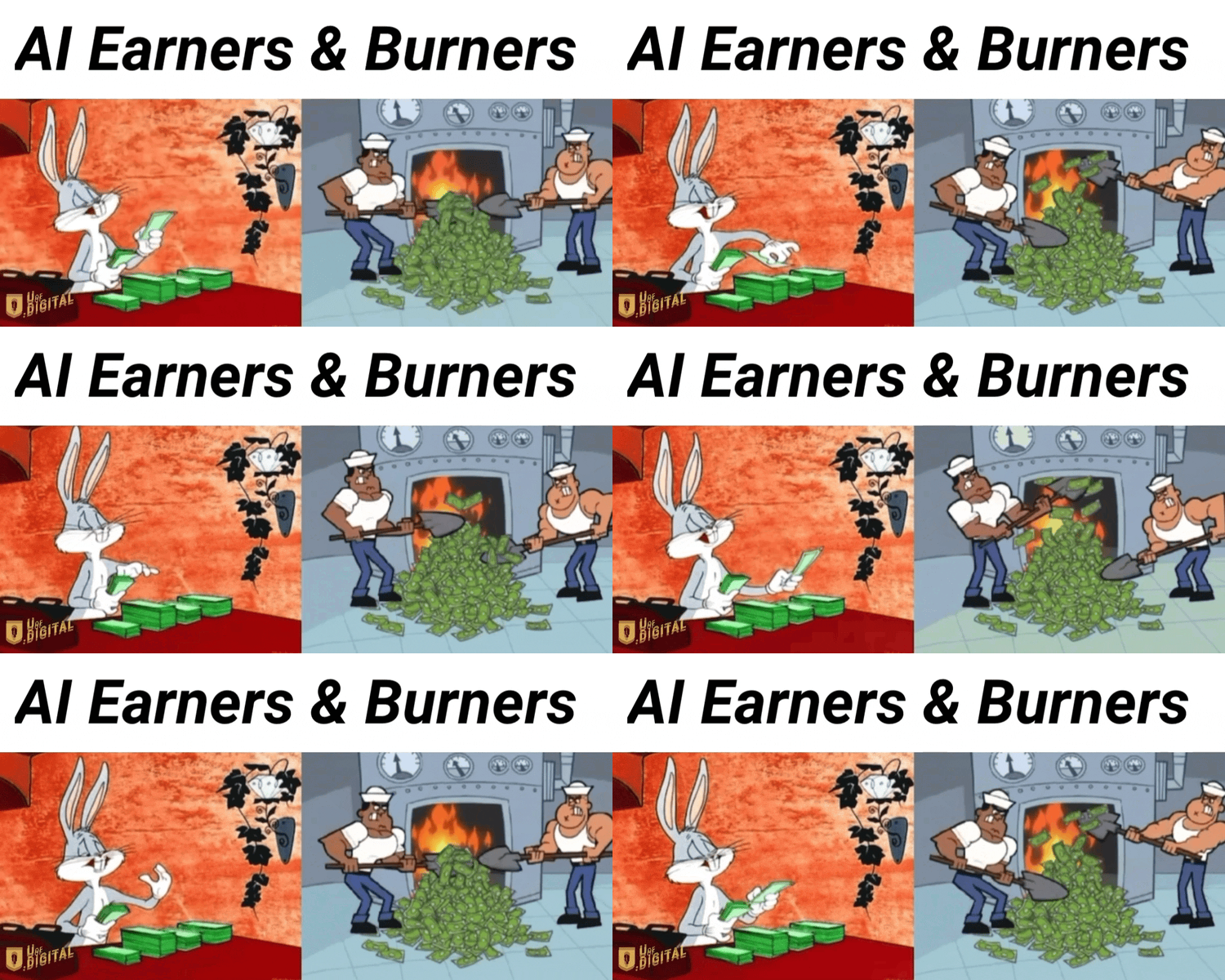
Then come the AI Burners, those spending heavily on AI with profits still more promise than proof. Meta leads that camp, pouring over $70 billion into AI initiatives built mostly around smarter ad targeting and early consumer products like wearables. The company just posted 26% revenue growth and 240 million new daily users. Yet its stock slipped 9%. Alphabet’s ad business grew only 12.6%, but its shares climbed 5%, because investors can see where the AI dollars are actually landing.
U of Digital’ Reading List:
- 2024 Zero-Click Search Study: For every 1,000 EU Google Searches, only 374 clicks go to the Open Web. In the US, it’s 360. – SparkToro
- As AI Search Threatens Open-Web Ad Supply, DSPs Face a Reckoning
- AI Visibility 101 and Best Practices for Brands – U of Digital
U of Digital’ Playlist:
- Episode 1 – Sam Altman on AGI, GPT-5, and what’s next
- OpenAI Prepares ChatGPT for Ad Driven Era, The AI Paradigm Shift | Keith Rabois, Alfred Lin, Keith Sakata, M.D., Talia Goldberg, Dave Girouard, Kylan Gibbs, Sam Jones, Zach Pogrob
- Sam Altman on Trust, Persuasion, and the Future of Intelligence – Live at the Progress Conference
Perpexity vs. Amazon: A big showdown over agentic commerce
The episode’s third act turned to e-commerce and to Shopify vs. Amazon companies, taking radically different approaches to AI. Before diving into how they’re playing offense, it’s worth noting the legal spark that lit the debate: Amazon recently fired a cease-and-desist at Perplexity AI for allowing its “agentic” browser to make purchases on Amazon’s site.
That clash highlights a deeper tension in e-commerce: whether AI shopping will expand consumer choice or concentrate power inside a few platforms.
Shiv Gupta (Host): “Amazon is generally blocking AI crawlers from looking at inventory. On the other hand, Shopify, the anti-Amazon, is leaning all the way in with a pro-AI stance, trying to democratize e-commerce.”
Krish’s point cut to Amazon’s DNA: control the ecosystem, control the outcome. The walled garden isn’t rejecting AI; it’s rejecting unregulated AI. Shopify, by contrast, is betting that openness creates opportunity.
Krish Raja (Guest): “Amazon has a deep partnership with Anthropic. I don’t think they’re anti-AI; I think they’re anti-open marketplace AI. If an AI agentic browser is going to do something on their site, it better be controlled by Amazon or their trusted partner, Anthropic. The Amazon marketplace has tight margins, and if people mess with pricing and can access different products at unforeseen prices, it has a messy effect on Amazon’s business. It’s about taking full control of the AI.”
The walled garden now faces a clear dilemma: protect its margins or move first to shape what comes next.
Shiv Gupta (Host): “When new technology potentially disrupts your business, you have a tough decision: go with the flow and disrupt yourself, or put up a wall to protect business interests, even if it means making the consumer experience worse. There are many examples where companies got disrupted by playing that game.”
Shiv’s co-host made it clear: Amazon’s fear isn’t of AI itself, but of letting anyone else’s AI inside its walls, something Shopify openly welcomes.
Myles Younger (Co-Host): “Amazon knows it’s a first stop for shopping. If they allow outside AI bots to start hitting their site and buying things, they have automatically made themselves a second stop, which Amazon does not want. Shopify is happy being a second or third stop, and they love more first stops because it means more traffic for them.”
U of Digital’ Reading List:
- Amazon’s alliance with Anthropic is paying off handsomely for the tech giant’s cloud business
- EXCLUSIVE: Perplexity Ad Chief Taz Patel Departs
- Media Briefing: Here are the hurdles to Perplexity’s pitch as the publisher-friendly LLM
- Bullying is Not Innovation
- Statement about Perplexity
- Amazon Sues to Stop Perplexity From Using AI Tool to Buy Stuff – Bloomberg
Final Takeaways: The Marketer’s Cheat Sheet
After unpacking AI creativity, monetization, and commerce, the episode wrapped with a set of grounded lessons for marketers and reminders that this new era of AI isn’t just about tools, but about choices.
Krish Raja (Guest): “In general, I’d say just realize the relationship between yourself and AI is the most important thing. If you’re not using AI to improve yourself, you’re improving AI one way. If we are just improving AI, and AI isn’t improving us—and we are blindly trusting it—it is a dangerous slippery slope for all of us. AI is a fantastic tool that can enrich you, but use it with a critical thinking lens and understand the relationship you’re getting into. It’s super important for marketers to vote with their dollars as well.”
Myles Younger (Co-Host): ”Less risk of job loss. Coca-Cola, one of the biggest brands, had a team of about a hundred people making an AI ad, and it was still pretty mediocre. AI is a tool that can enhance mockups or concepting, but not necessarily a finished product. Marketers should look at their 2026/2027 strategy and be mindful of the motivations of all these platforms.”
Shiv Gupta (Host): “If you’re a marketer, don’t make big bets [ with AI] that hook you into something and tie you down. Make lots of small bets.”
For more AI news, data drops, and reading lists, check out the AI Edge Newsletter and U of Digital’s latest training sessions at uofdigital.ai. New episodes drop every week. Tune in, read along, and get your edge.
FAQs
What is earned media?
Earned media is the unpaid visibility and positive attention a brand receives from third-party sources, such as news coverage, social-media mentions, influencer endorsements or consumer word-of-mouth, rather than through advertising or channels the brand owns.
For example, when Coca-Cola launched its AI-generated “Holidays Are Coming” ad and the story went viral (sparking reactions across media and social channels), it gained earned media not because it paid for that coverage, but because people outside the brand were talking about it.
What is zero-click?
A zero-click interaction occurs when a user’s query or intent is fully resolved on the platform (search engine, AI assistant, agentic browser) without the user having to click through to a brand or publisher site. As this becomes the norm, the traditional ad inventory, based on clicks, site visits, and ad-slots, shrinks, ushering in an “ice age” of ad inventory where fewer impressions and placements are available for advertisers.