
What is the U of Digital’s AI in Ad Tech Knowledgescape?
The U of Digital’s AI in Ad Tech Knowledgescape is an interactive map built to make sense of how AI is transforming the ad tech and to show the many different ways AI is used across the ecosystem and campaign lifecycle.
While we aimed to cover a broad range of ad tech vendors and AI-driven solutions, this version is an MVP, a first iteration designed to grow and evolve over time. It’s our initial attempt to help brands and advertisers see just how diverse the AI in the ad tech landscape truly is. We recognize that major ad tech players have expansive suites of AI products, but our goal wasn’t to capture every single one. Instead, we focused on showing the different ways companies are applying AI.
For some, we highlighted their core native AI products; for others, their assistants or embedded AI features. Some are represented by recently acquired AI solutions, while in other cases, we showcased an incumbent’s entire suite of AI offerings. The goal isn’t to present an exhaustive catalog, but to reveal the breadth and variety of approaches, from agile startups to holding companies, from single AI assistants to full end-to-end intelligent systems.
How to use the U of Digital’s AI in Ad Tech Knowledgescape?
The AI in Ad Tech Knowledgescape is designed to be fully interactive, not just something you look at, but something you explore. Every feature is built to help you quickly find, compare, and understand how AI is being used across the ad tech ecosystem.
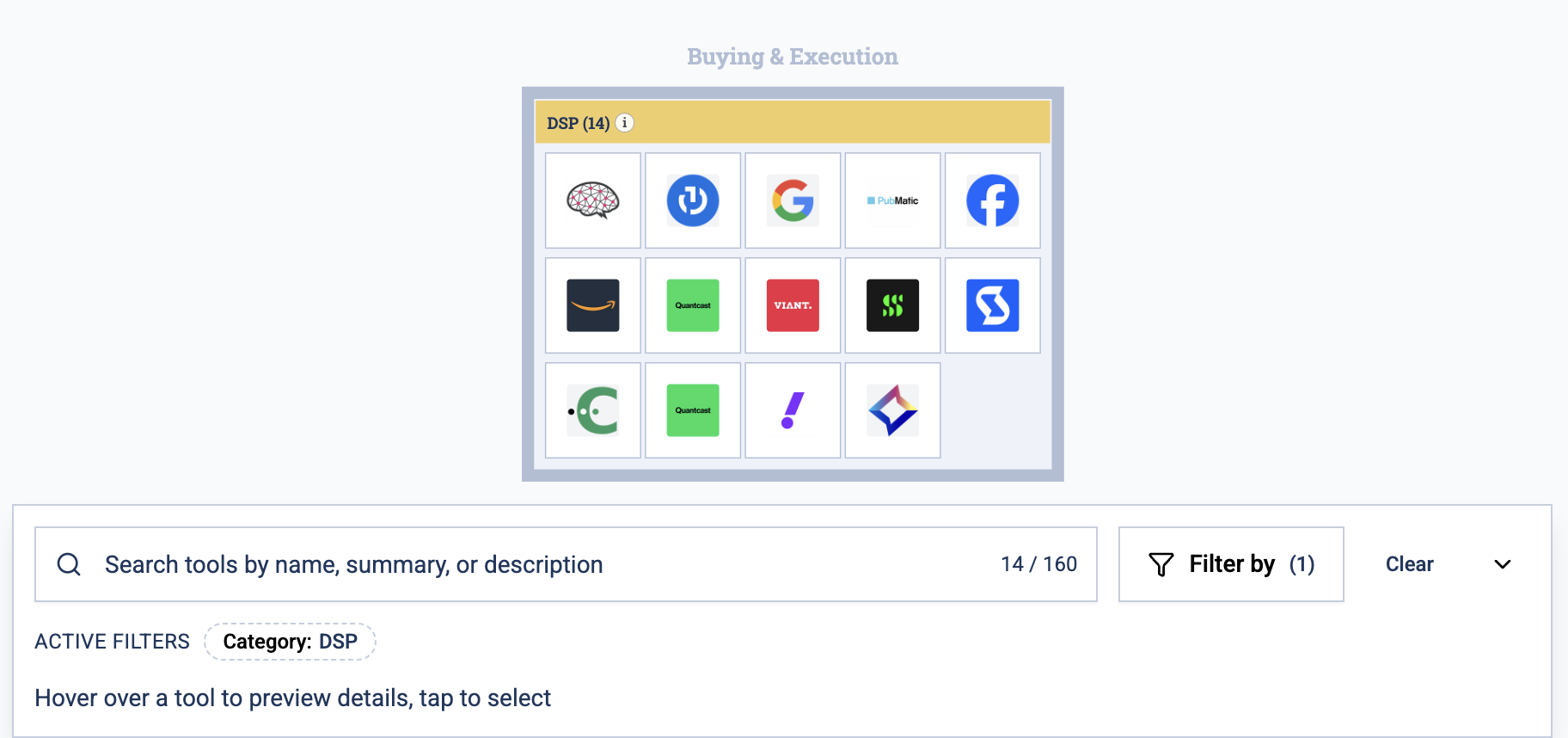
You can filter the map by category to focus on a specific part of the ecosystem, whether that’s DSPs, Creative Optimization, Ad Verification, or Data Platforms. This lets you narrow down the view and see only the companies relevant to that segment.
Use the search bar to find any company instantly. As you type, results appear dynamically, so you can locate vendors or specific AI tools in seconds.

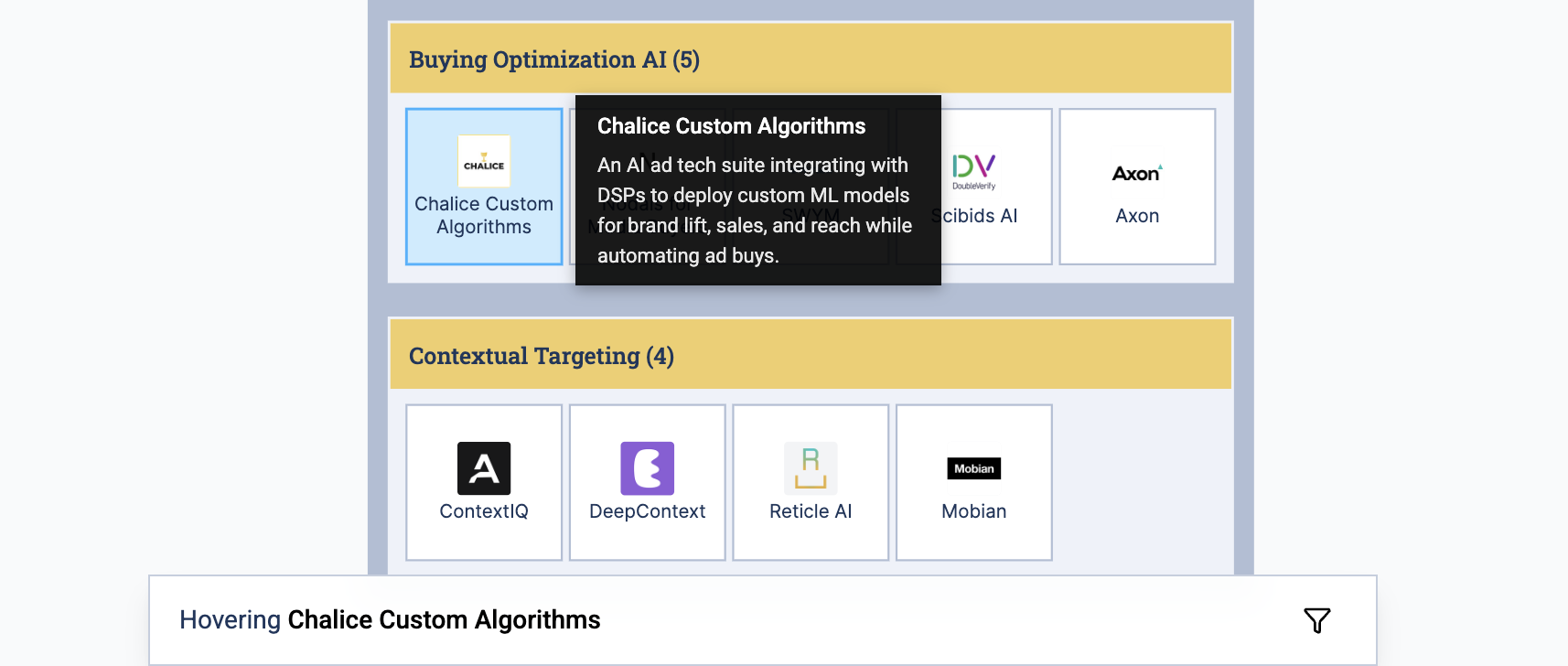
When you hover over a company tile, a tooltip will appear with quick, at-a-glance information including the company name, its product category, and a short description of its AI function. It’s a simple way to get context without losing your place on the map.
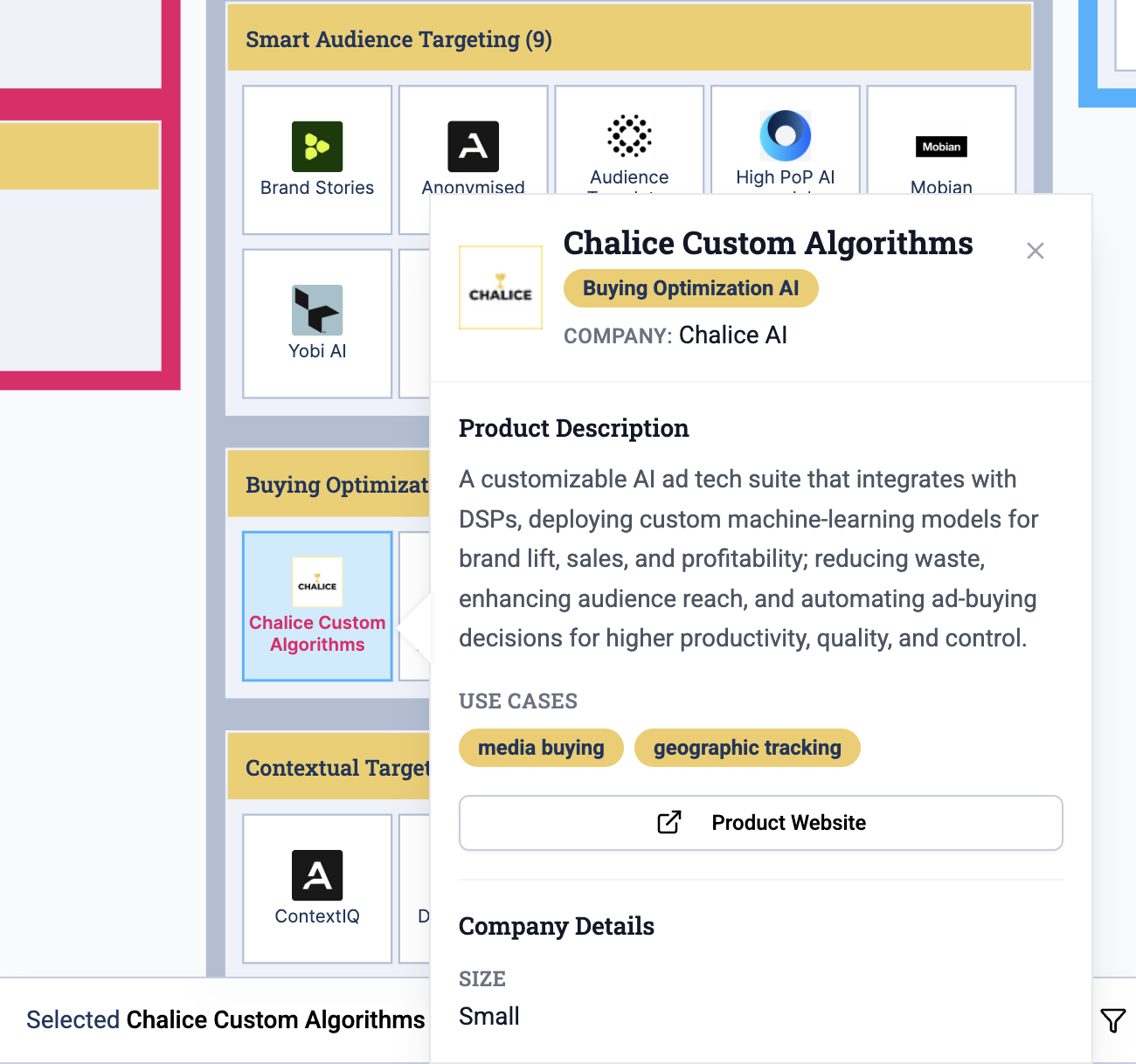
For deeper insight, click on a tile to open a full company and product card. Here, you’ll find more detailed information, such as the company’s size, status, and key use cases, for example, whether they focus on optimization, measurement, or creative automation. You can also access a direct link to their website to explore further.
Together, these features turn the Knowledgescape into an active learning tool, a way to navigate the complexity of AI in ad tech through exploration, not just observation.
How is this AI in the Ad Tech Landscape organized?
Categories in the AI in Ad Tech Knowledgescape are a framework, not a formula. Many innovations cut across boundaries: a single platform might manage data, optimize creative, and measure performance all at once. Still, without some structure, the landscape would be impossible to navigate.
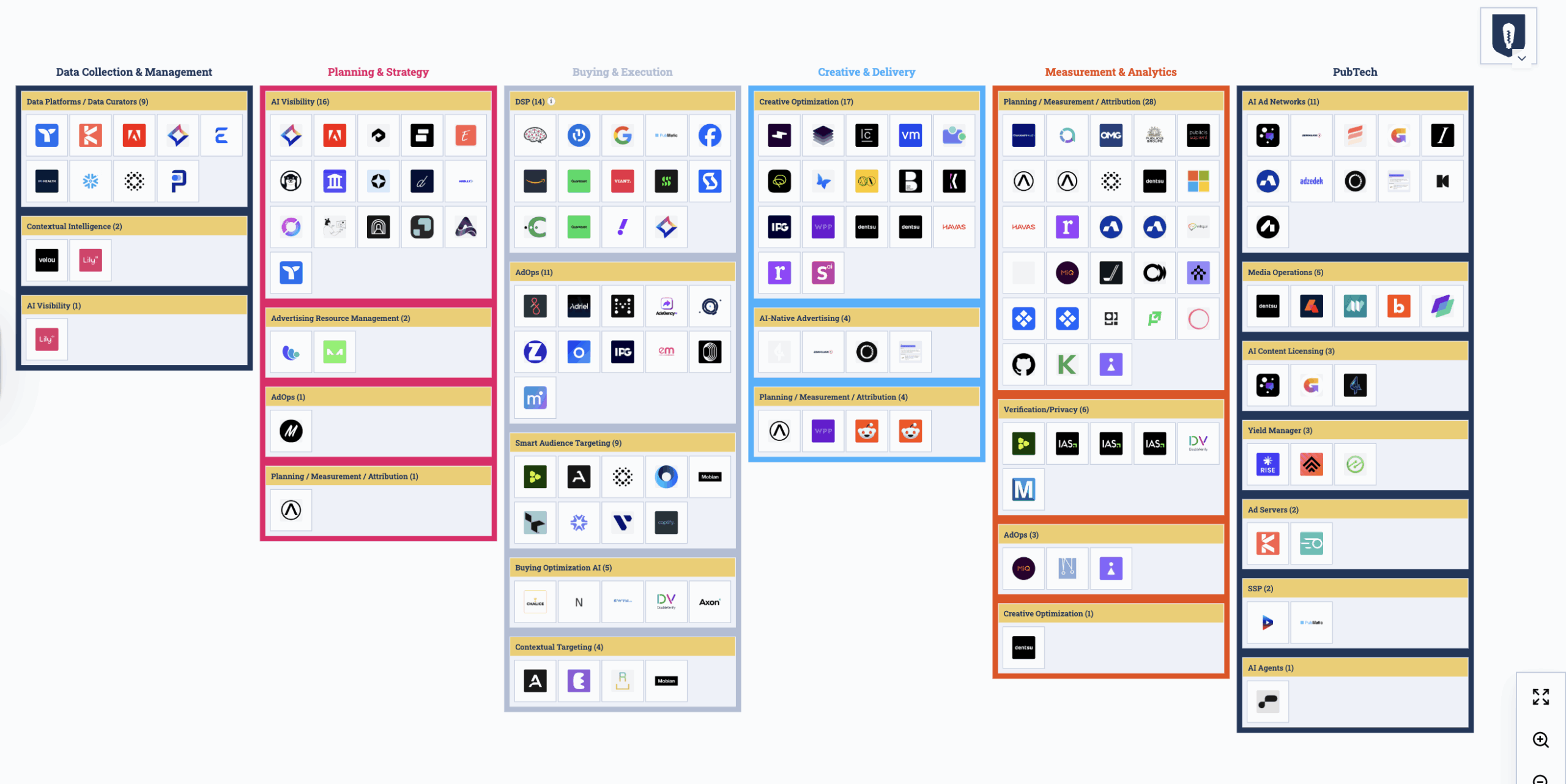
To bring clarity, we’ve organized the map into five broad pillars that reflect the full campaign lifecycle: Data Collection & Management, Planning & Strategy, Buying & Execution, Creative & Delivery, and Measurement & Analytics.
Within these pillars are more specific categories, such as DSPs, Contextual Intelligence, Ad Verification, or Creative Optimization, representing distinct yet overlapping capabilities.

It’s also important to note that some technologies are used by both advertisers and publishers, while others are more specific to one side. For example, CDPs (Customer Data Platforms) often serve as shared infrastructure across buy and sell sides, whereas tools like Media Operations platforms or AI Content Licensing systems are typically designed for publishers and not used directly in campaigns.
These categories aren’t meant to be rigid boxes but guideposts to help you understand where AI applications fit and how they connect across the ecosystem.
How is AI transforming each layer of ad tech?
Each category in the AI in Ad Tech Knowledgescape represents a distinct function within the advertising technology ecosystem and a different way AI is being applied to make that function smarter, faster, or more autonomous. Here’s what each one includes:
Smart Audience Targeting
Tools and platforms that use AI and advanced analytics to identify, segment, and predict high-value audiences based on behavioural, contextual, first-party (and/or anonymised device-level) data, enabling advertisers to reach the right people or cohorts at the right time with more precision, while reducing reliance on third-party cookies, persistent identifiers, or individual-level tracking.
Contextual Intelligence
Platforms that interpret the meaning and relationships within data, such as product attributes, customer language, imagery, and behavioral cues, to deliver the most relevant and accurate experiences. AI models in this category go beyond simple keywords or metadata to understand product context, shopper intent, and channel environment, enabling more precise discovery, personalization, and conversion across digital touchpoints.
Advertising Resource Management (ARM)
An AI-powered platform category that unifies and automates the entire advertising lifecycle, spanning strategy, media planning, activation, optimisation, insights, and financial reconciliation. AI within ARM platforms powers conversational reporting that delivers real-time insights through natural-language interfaces; predictive planning that forecasts outcomes and optimises media mix and budgets; intelligent alerts that surface actionable cross-channel recommendations; governance tools that detect workflow bottlenecks, enforce compliance, and align teams; and autonomous agents that continuously adjust pacing, bids, and financial reconciliation to maximise campaign efficiency.
AI-Native Advertising
Advertising technology built specifically for AI environments. These platforms integrate directly with AI agents, LLMs, and conversational interfaces to analyze real-time interactions and context (without relying on PII). They use AI to create, optimize, and deliver contextually relevant ad experiences, giving advertisers access to dynamic new formats and performance insights designed specifically for AI ecosystems.
AI Agents
Autonomous or semi-autonomous systems that assist marketers or publishers in managing campaigns, optimizing spend, or making strategic recommendations. These can act as “co-pilots” for campaign planning, reporting, or performance management.
Contextual Targeting
AI-powered solutions that analyze the meaning, sentiment, and sensory context of digital environments (text, imagery, audio, tone, and emotion) to deliver ads aligned with the surrounding content rather than individual user data. These systems dynamically interpret page topics, scene context, and brand suitability signals to ensure privacy-safe, brand-safe, and emotionally resonant ad placements. Leveraging multimodal AI, they enable advertisers to activate campaigns across channels (web, CTV, mobile, in-app) with precision, transparency, and adaptability, optimizing engagement, recall, and performance through real-time understanding of content and audience intent.
AI Content Licensing
These are the monetization and licensing platforms that connect publishers, creators, and rights holders to AI builders via standardized protocols such as the Model Context Protocol (MCP). They enable rights-cleared, per-query access to real-time content for retrieval-augmented generation (RAG), copilots, and agentic applications, ensuring attribution, compensation, and transparency. AI Content Licensing platforms empower publishers to protect and monetize IP, integrate live context into AI systems, and facilitate content-to-LLM partnerships through embedded marketplaces, analytics, and discoverability features.
Identity Resolution
Tools and platforms that use AI and advanced analytics to stitch together identifiers (such as device IDs, cookies, emails, offline records) from multiple channels and touchpoints, in order to build a unified, persistent profile of an individual or household. Leveraging machine learning models, these systems probabilistically and deterministically match disparate data, clean and standardize inputs, and continuously learn to improve matching precision.
Media Operations
An AI-powered orchestration and automation platform for publishers and media organizations that streamlines the complete ad operations lifecycle from campaign setup and trafficking to monitoring, optimization, and reporting. Integrated AI engines automate repetitive workflows, identify discrepancies in real time, and predict performance outcomes before issues arise. Deep integrations with ad servers, CRMs, and data pipelines ensure transparent, auditable execution across systems. The platform empowers ops teams to make data-driven decisions faster, reduce manual effort, and drive operational excellence through continuous optimization, intelligent recommendations, and predictive efficiency.
Planning / Measurement / Attribution
Platforms that use AI for campaign planning, predictive modeling, and performance evaluation. They help advertisers understand what’s working, attribute results across touchpoints, and plan future spend.
SSP (Supply-Side Platform)
Platforms that help publishers manage, price, and sell their inventory programmatically. AI is used for dynamic yield & pricing optimisation, automated deal creation and management, predictive monitoring and troubleshooting, competitive benchmarking and demand insights, brand-suitability and inventory classification.
Verification / Privacy
AI-powered platforms that safeguard media quality, brand integrity, and consumer trust by ensuring ads run in safe, viewable, and privacy-compliant environments. These solutions use machine learning and large language models to detect fraud, assess contextual suitability, and adapt to evolving global privacy regulations. By combining real-time content analysis, anomaly detection, and automated compliance modeling, they help advertisers to verify inventory quality, prevent misplacement and misinformation risks, and maintain transparency across the ad supply chain.
Yield Manager
AI-powered platforms that help publishers maximize ad revenue by optimizing pricing, demand, and placement decisions in real time. These solutions leverage machine learning and predictive modeling to adjust floor prices, unify demand sources, and refine auction dynamics based on performance data. By continuously analyzing user behavior, bid patterns, and contextual factors, they ensure efficient yield management, transparency across demand partners, and higher eCPMs.
Ad Servers
AI-powered ad tech platforms that manage the delivery, tracking, and optimization of digital ads across channels. Modern ad servers use machine learning to analyze audience data, automate targeting and creative selection, optimize placement and frequency in real time, and detect ad fraud. This intelligent orchestration ensures each impression is served to the right user, at the right time, with the right message.
AdOps
These are operational platforms and automation systems that streamline and optimize the end-to-end advertising lifecycle from campaign creation and creative generation to performance analysis and real-time optimization. These platforms integrate with multiple ad networks and data sources (e.g., Google, Meta, TikTok, CRM, analytics tools) to automate repetitive tasks, normalize and unify data, and surface actionable insights through natural language interfaces or intelligent agents.
They help marketers and agencies to:
-
- Automate campaign management (e.g., budget allocation, ad pausing, creative optimization)
- Automate campaign management (e.g., budget allocation, ad pausing, creative optimization)
-
- Generate and adapt creative assets using AI (text, image, and variant generation)
- Generate and adapt creative assets using AI (text, image, and variant generation)
-
- Deliver real-time, cross-channel performance insights
- Deliver real-time, cross-channel performance insights
-
- Optimize media plans and targeting decisions dynamically
- Optimize media plans and targeting decisions dynamically
-
- Ensure compliance, consistency, and scalability across campaigns
- Ensure compliance, consistency, and scalability across campaigns
AI Ad Networks
AI ad networks are advertising monetization platforms built for generative AI and conversational environments, enabling developers and publishers to integrate context-aware, intent-driven ads directly into chat, search, and AI-generated responses. These networks connect brands with high-intent users by using real-time semantic understanding, dynamic targeting, and AI-generated creatives to deliver native, conversational ad experiences that align with user context and intent. They provide SDKs or APIs for seamless integration, support cross-format delivery (text, banner, box, query-based), and include analytics, attribution, and optimization tools to maximize engagement and revenue across AI-driven interfaces.
AI Visibility Tools
These platforms or modules within larger platforms allow organizations to monitor, analyse and optimise how their brand, content, or products are mentioned, cited or recommended within AI-powered answer systems (such as LLMs and AI search engines), by tracking prompts, query coverage, citations and competitive benchmarks, helping them enhance their presence and influence in a landscape driven by AI-based discovery.
Buying Optimization AI
AI-driven systems that enable advertisers to deploy bespoke bidding algorithms tailored to their unique business goals (such as brand-lift, sales uplift, margin optimisation, or audience quality) rather than relying on generic bid logic. It ingests proprietary first-party and third-party data, real-time signals (e.g., impression-level, context, attention, supply-path quality), and models the value of each opportunity, then dynamically generates bid/no-bid decisions, bid amounts, supply-path selection, and pacing across DSPs or ad tech stacks. These systems integrate supply curation, data enrichment, and workflow automation, giving advertisers transparency, data ownership, and strategic control while reducing waste, optimising ROI, and scaling buying operations
Creative Optimization
An AI-powered solution category that unifies creative generation, automation, and performance optimization to produce, personalize, and scale digital ad assets across channels. These platforms combine generative AI, dynamic creative optimization (DCO), and data-driven analytics to automate image, video, and copy creation; test and refine variants; and integrate directly with marketing and media ecosystems for continuous improvement. Designed for brands, agencies, and enterprise marketing teams, Creative Optimization solutions transform creative workflows into intelligent, adaptive systems that deliver higher-performing, brand-safe, and contextually relevant content at scale.
Within this category, solutions can be grouped into three subcategories based on their scope, integration depth, and enterprise orientation:
Standalone Creative Automation Tools
Independent SaaS platforms focused on creative generation, testing, and automation.
- AdCreative.ai
- Marpipe
- Creative Studio AI by VidMob
- AI Studio by Smartly
- Creative Automation by Celtra
- Creative Management Platform by Bannerflow
Integrated Modules within Platforms
Specialized creative optimization or experimentation units embedded within larger ad tech, martech, or media ecosystems. These are designed to extend automation and intelligence capabilities.
- streamr.ai, a part of Magnite
- Ads inspiration library and AI copywriter, a part of Reddit Ads
- Vermeer, a part of Havas’s Converged.AI product suite
Enterprise-grade Creative Intelligence Environments / Creative Clouds
Comprehensive AI-driven environments and creative ecosystems developed by major agency networks, holding companies, or enterprise technology platforms. These are designed for large-scale, cross-channel creative transformation and operational integration. These systems often include multiple integrated modules for creative generation, performance optimization, asset management, and workflow automation.
- Collective AI by TBWA (Omnicom)
- Production Studio by WPP
- AI Playground by Dentsu
- d.SCRIPTOR by Dentsu
- The Razorfish Virtual AI Content Studio by Razorfish (Publicis Groupe)
- Pencil AI
- RAND by DDB (Omnicom)
- Experimentation Lab by Kinesso (IPG)
- IPG Engine by IPG and Adobe GenStudio
Data Platforms / Data Curators
This is the foundational category of the marketing and advertising technology ecosystem that collects, integrates, stores, and standardizes customer and audience data to power targeted advertising, measurement, and personalization across digital channels. It underpins how advertisers and publishers manage first-, second-, and third-party data for activation in programmatic and omnichannel campaigns. Core solutions within the data layer include Analytic Data Environments, Customer Data Platforms (CDPs), Customer Relationship Management (CRM) systems, Data Clean Rooms (DCRs), Data Lakes, Data Warehouses, Identity Graphs, LLM Data Warehouses, and Master Data Management (MDM) platforms. AI and ML are embedded throughout the data layer to automate data integration, enhance data quality, and generate actionable insights from complex datasets. They enable predictive modeling, real-time decisioning, and adaptive personalization, transforming raw data into intelligence that drives more efficient targeting, measurement, and creative optimization. In essence, AI and ML make the data layer an intelligent, self-improving foundation that powers the ad tech ecosystem.
DSP (Demand-Side Platform)
Ad tech platforms that enable advertisers and agencies to buy digital advertising inventory across multiple publishers and exchanges automatically and in real time. They serve as the operational core of programmatic advertising, coordinating bids, budgets, audience targeting, and campaign optimisation across channels like display, video, mobile, and connected TV.
AI/ML in a DSP is used across many parts of the media buying workflow:impression-level forecasting/value-estimation, dynamic bidding/bid optimization, audience discovery/targeting/segmentation, supply-selection/placement optimisation, budget and pacing optimisation, creative optimisation/dynamic creative/personalisation, incrementality/measurement/lift modelling, fraud detection/brand safety/viewability.
Modern DSPs are increasingly augmented by Buying Optimization AI. These advanced AI-driven systems allow advertisers to deploy bespoke bidding algorithms tailored to their unique business objectives (such as brand lift, sales uplift, margin optimisation, or audience quality) rather than relying on generic bid logic.
What idea sparked the U of Digital’s AI in Ad Tech Knowledgescape?
The idea for the U of Digital’s AI in Ad Tech Knowledgescape grew out of our AI Accelerator sessions, where students kept asking for a single, reliable resource that showed how AI is being used across the ad tech ecosystem. When we looked for one, we realized it didn’t exist; there was no objective, ecosystem-wide map that connected the dots. Most of what we found were flashy slides from VCs promoting their portfolios or static walls of logos with no context or explanation. That’s what inspired us to create the Knowledgescape: a living, interactive framework that actually helps the industry see how AI fits together, not just where the logos sit.
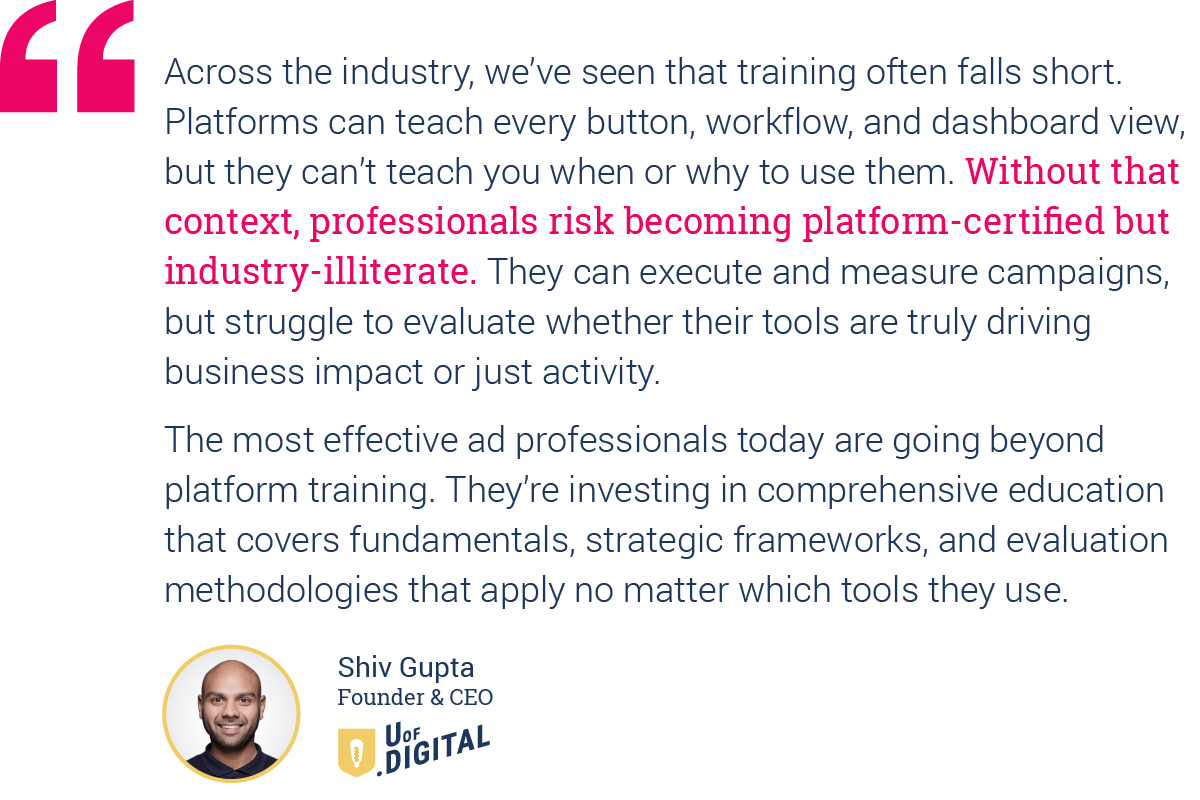
Shiv’s belief that real expertise comes from understanding the bigger picture, not just knowing how to use the tools, inspired the Knowledgescape. We built it as a living, interactive framework that helps the industry see how AI fits together, not just where the logos sit.
The future of the AI in Ad Tech Knowledgescape
The U of Digital’s AI in Ad Tech Knowledgescape is just the starting point, a foundation we plan to expand into a richer, more interactive, and intelligent resource for the industry.
In the next phase, we plan to introduce an AI assistant built directly into the map, a conversational layer that allows users to explore the landscape through dialogue rather than clicks. Instead of filtering and searching, you’ll be able to ask questions like “Which companies use AI for contextual targeting?” or “Show me examples of AI-native ad platforms.” The assistant will respond instantly, drawing on the data behind the map to provide insights and connections in real-time.
We’ll also be adding a new layer of taxonomy focused on AI architecture, showing how AI is implemented within each product. This will help users understand not just what the technology does, but how deeply AI is integrated into its core. The framework will include:
-
- AI-native products: Products born with AI as their foundational technology or decision engine, where intelligence drives the product’s entire function.
-
- Products with embedded AI: Established or legacy ad tech solutions that have integrated proprietary AI into specific workflows or modules.
-
- Wrappers (with external AI): Tools that embed or interface with non-proprietary models (e.g., ChatGPT, Claude, LLaMA) to extend functionality without building their own AI.
-
- AI agents: Systems that autonomously orchestrate or make decisions across multiple ad tech components, acting as intelligent connectors between tools.
-
- AI assistants (conversational interfaces): Natural-language chatbots attached to ad tech products that help users query data, analyze insights, or execute tasks through conversation.
- AI assistants (conversational interfaces): Natural-language chatbots attached to ad tech products that help users query data, analyze insights, or execute tasks through conversation.
Beyond these layers, future releases will include more detailed use cases for each product, showing how AI is being applied in real-world campaigns. For a deeper exploration, we plan to develop U of Digital’s expert overviews and advisory notes, accessible directly from each product card, helping users understand not only what a solution does, but also when and why to use it.
Call for feedback and community help
We’d love your feedback! The AI in Ad Tech Knowledgescape is a living project, and we’re building it with the community. Tell us what makes sense, what could be clearer, and what you think we should do next to make this resource even more useful.
If you notice any major categories or standout companies we’ve missed, especially those that would be most helpful to brands and advertisers exploring how AI fits into their workflows, we’d love to hear your suggestions.
Please send any feedback, company suggestions, or questions to [email protected]. If you’d like to discuss the Knowledgescape further, include your preferred contact information, and we’ll reach out.
Thank you!
FAQs
What are synthetic audiences?
Synthetic audiences are AI-generated populations designed to behave like real consumers. They’re built using real-world behavioral and qualitative inputs, not random generation. They are scalable, data-grounded models of real segments.
Are synthetic audiences replacing real research?
Not today, and maybe not ever. Right now, they’re being used primarily for: speed (to get early signals quickly), exploration (to test ideas before real-world spend, and iteration (to refine concepts before involving human panels). The direction we are heading: hybrid workflows, where synthetic audiences accelerate early research and human panels confirm or refine the insight.