

Editor’s note: As part of our U of Digital AI Literacy Alliance series, Dstillery explains how multimodal AI can help advertisers move beyond the constraints of silos, toward more adaptive, cross‑channel targeting.
Why Following Clicks Has Never Been Enough
For years, digital advertising relied on channel-specific tools to find audiences and buy media to effectively reach them. Early AI followed the same pattern, with separate models for search, display, social, or CTV, each trained on a single data stream in isolation rather than the full multimodal customer journey. But real-world consumer behavioral journeys don’t occur in silos. As people move across sites of interest, they encounter and generate many different modalities at once — text, images, audio, video, and behavioral signals — that do not fit neatly into single-channel patterns. The industry has shifted from “following user clicks” to “understanding the user journey and the moment.” Just as we are all multi-faceted individuals, user behaviors are best predicted not as single-modality models but instead, with multimodal AI, connecting those signals in one unified system.
When More Data Creates Fragmentation, Not Better Targeting
Advertisers and their agencies now have access to more heterogeneous data than ever: site tags, search terms, product feeds, campaign and ad exposure logs, CTV viewership, and signals from podcasts or streaming services.
And while advertiser data volume may seem advantageous, the key is quality over quantity. A small but accurate seed of a brand’s best customers often outperforms a large, disconnected dataset. Yet, all too often, these inputs are still modeled and activated in silos, making it hard to turn them into coherent targeting signals for top-performing campaigns. The resulting fragmentation, latency, and guesswork mean brands and their agencies lose out on precision, ultimately compromising results. Bigger datasets or faster models won’t solve these problems; brands and agencies need targeting that can adapt to more predictive, cross‑channel environments.
Omnichannel Targeting Strategies Have Been Around for Years; How Is This Different?
Marketers often define their target audiences, perhaps through a set of descriptive attributes, and then reach those audiences across channels in one of two ways – qualitative matching or device graphs.
Dstillery Chief Data Scientist, Melinda Han Williams, explains: “Multimodal AI goes a level deeper, bringing cross-context connections directly into the model’s training space. Beyond gaining a more precise view of a brand’s best customers across data types, learning in a multimodal space unlocks flexibility for model inputs and outputs that otherwise wouldn’t be possible.”
How Multimodal AI Works (Simplified)
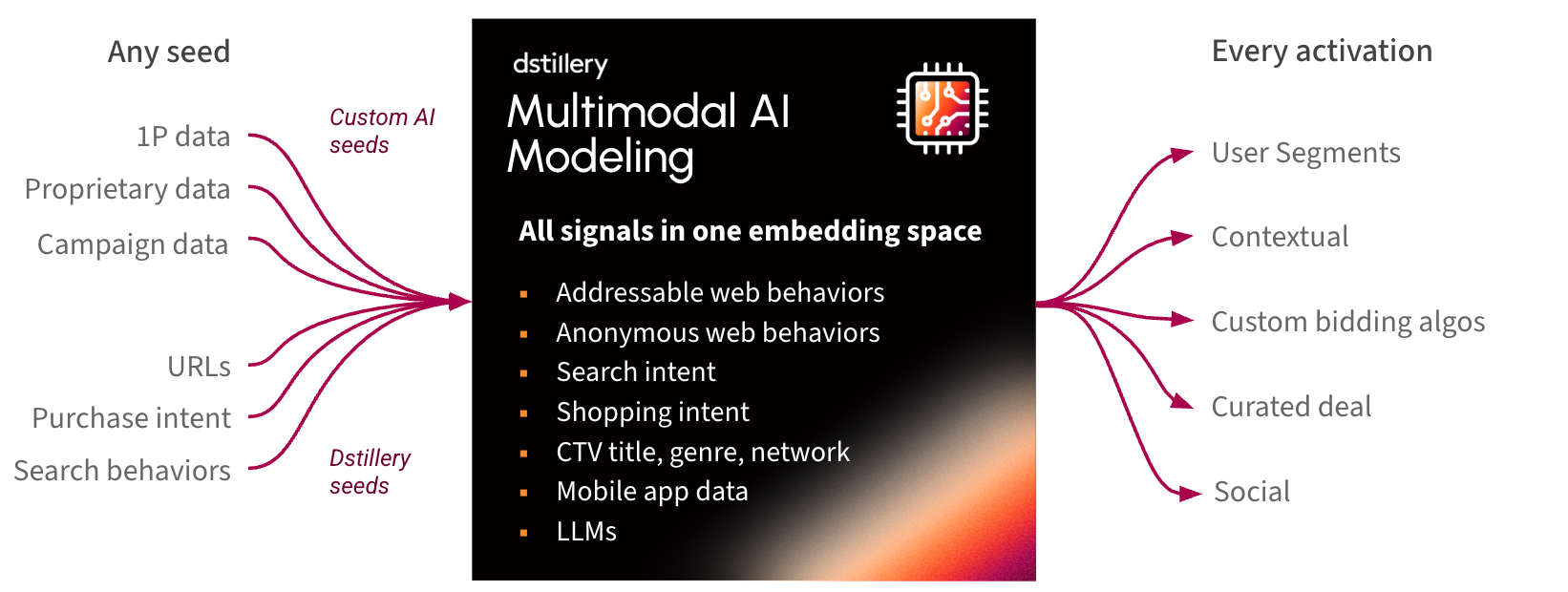
At its core, multimodal AI represents digital behaviors, or data points, from different contexts, or modalities, in one common space to use as the foundation for modeling. Instead of treating a search term, a URL, or a CTV show as separate objects, the system converts each into a point in a shared mathematical space, or embedding, where similar behaviors and interests sit close together. The model learns that space across many signals at once, so behaviors tied to similar outcomes cluster together even without a common ID. Those points in the shared embedding space then become a common behavioral map to reach users regardless of modality or silo, ensuring the highest value for a brand’s campaigns.
Multimodal AI Is Powerful, but Not Magic
Multimodal AI does not, by itself, solve today’s targeting challenges; it provides the connective tissue advanced agentic systems will rely on to understand and operate across modalities. For that foundation to work, agencies and brands need to test multiple tactics, share learnings with their partners, iterate on models, and align around clear KPIs. Success depends on strong inputs, transparency, and an ongoing willingness to learn what delivers results.
– Patti Boyle, Chief Marketing Officer at Dstillery