

Editor’s note: We’re excited to release the first in a new series of posts where U of Digital AI Literacy Alliance partners contribute explainers and perspectives to help our industry understand and apply AI.
Thanks to Optable for contributing this post!
Premium Programmatic Is Growing—But So Is Complexity
Over the last several years, the programmatic advertising landscape has shifted away from the open marketplace toward more controlled environments such as Private Marketplaces (PMPs), Programmatic Guaranteed deals, and curated marketplaces.
Premium channels offer more control over inventory access and pricing, and this shift has allowed publishers to better package their inventory, define who can access it, and capture more value from high-quality audiences and content.
For Ad Ops teams, the reality is more complex.
The Deal ID Bottleneck
One of the most visible symptoms of this shift is the rapid increase in Deal ID volume.
Ad Ops teams are often responsible for configuring deals across dozens of Supply Side Platforms (SSPs) and ad servers. This process can include mapping Deal IDs, setting pricing parameters, defining targeting criteria, and managing flight dates across platforms and partners. At scale, this creates a significant operational workload.
As the number of buyers and deals increases, so does the likelihood of inconsistency and error. Ad Ops has been buried in these tasks, leaving less time for high-level yield strategy and relationship management.
On the buy side, the discovery process for PMPs and Curated Deals has remained largely unchanged for the better part of a decade. Buyers are overwhelmed with an endless supply of media, data, and pricing that makes finding the best match for their campaign goals increasingly difficult.
A New Approach: Agentic Advertising
New AI-based approaches are emerging that aim to restructure how deals are discovered, configured, and activated. At the forefront of these is agentic advertising.
In this model, AI agents are deployed to handle different aspects of the transaction process and interact with one another to facilitate deal creation and execution. A true agentic marketplace between buyer and seller agents is still in its infancy, but the foundation is here.
Publishers can adopt Audience Agents and Sales Agents to represent their inventory, data, and pricing to buyers who are searching for the best Deal ID for their campaign.
How Agent-Based Deal Creation Works (Simplified)
This diagram illustrates how agent-based systems can connect buyers and sellers to automate parts of the deal creation process—from campaign request to execution.
At a high level, agent-based workflows shift deal creation from manual setup to system-driven matching and execution.
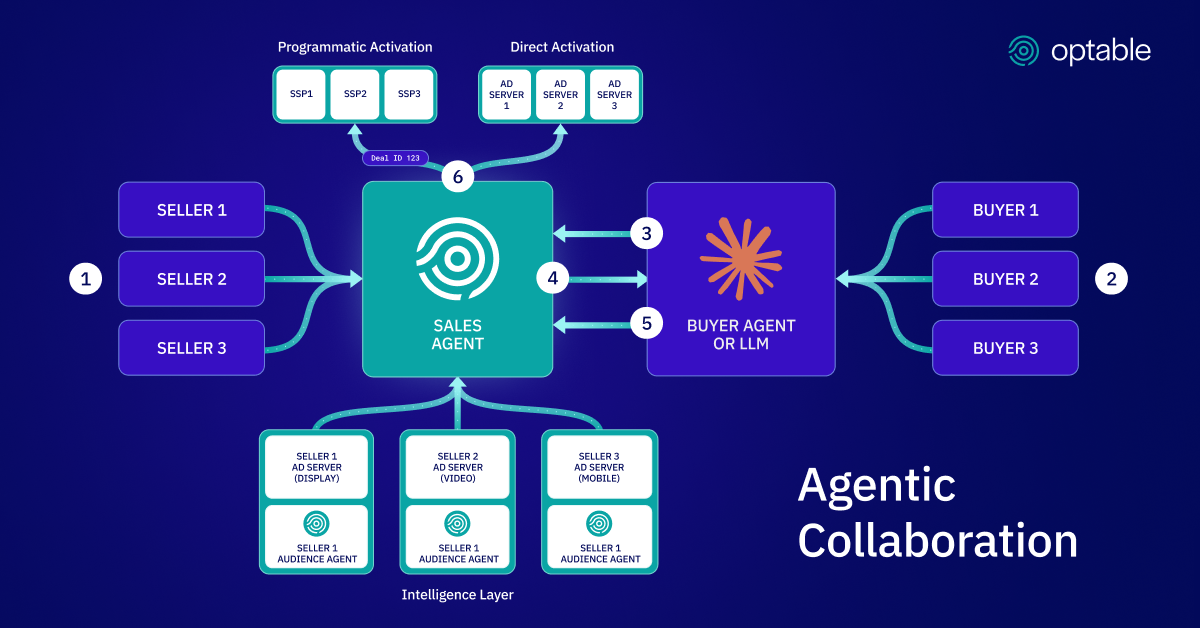
1. Sellers make inventory and audience data available
Publishers define what they have to sell, including inventory, audiences, and pricing.
2. Buyers connect through an agent or interface
Buyers input campaign goals or requests through a system that can interpret them.
3. The buyer submits a campaign request (RFP)
This request includes targeting criteria, budget, and objectives.
4. The system identifies matching opportunities
Available inventory and audience data are evaluated across multiple sellers to find relevant matches.
5. The buyer selects an option
The buyer reviews available opportunities and chooses which to activate.
6. The deal is created and executed automatically
Campaign details (e.g., Deal IDs, targeting parameters) are generated and pushed to the appropriate platforms.
What Has to Change for This to Work
For agent-based workflows to function, a strong signal infrastructure is key. Without it, there is nothing substantive for an agent to represent. Working with an Identity Graph, a Contextual Classification Provider, and an Audience Platform helps publishers build the necessary first-party data signals.
Agentic Advertising can help publishers can address the complexity bottleneck. The industry can move past the era where Ad Ops teams spend their days copying codes into spreadsheets, and toward an era where AI agents handle the executional minutiae.
Key Takeaways
As programmatic workflows continue to evolve and AI can take on more work that was previously executed manually, a few themes are emerging:
- Open auction buying is declining, while more controlled, premium transaction types are growing.
- Operational complexity has increased for Ad Ops teams as deal workflows have remained largely manual and fragmented.
- Agent-based approaches are emerging to automate parts of deal discovery, configuration, and activation.
Premium advertising requires intelligent, streamlined operations. We at Optable think it’s time to let AI agents lift the administrative burden.
– Andy Sharkey, VP Product at Optable