
For many travelers, there’s now a clear “before and after” moment in how they plan trips. Once you’ve asked an AI to design a long weekend in Lisbon, balance budget, flight times, walkable neighborhoods, restaurants you’ll actually like, and create a realistic day‑by‑day plan, it suddenly feels almost absurd to go back to typing rigid keywords into search boxes, opening 30 tabs, scrolling endless OTAs, and manually stitching together reviews and blog posts.
The old way of trip discovery starts to look like dial‑up in a fiber world.
Travel is one of the few categories where AI feels almost perfectly native: you describe what you want in your own words, and an assistant turns that into concrete options, trade‑offs, and itineraries.
In that sense, AI can feel like the interface for travel, one surface that replaces a whole maze of sites, filters, and comparison tools. But, as with every “perfect pairing,” there’s a but.
AI planning has its limits: its answers can be shallow, incomplete, or simply wrong; it still struggles with live availability, complex constraints, and the messy reality of real‑world operations. It is incredibly disruptive without yet being completely reliable.
In this article, we’ll unpack which new AI behaviors have actually stuck with travelers and which haven’t. We’ll look at why some parts of the journey (inspiration, rough planning) have shifted quickly into AI, while other steps (final choice, payment, service) are still fragmented across traditional channels. And we’ll argue that what incumbents like Google and disruptors like OpenAI have done for consumer trip planning is an important lesson for every airline, OTA, hotel brand, and loyalty program.
AI may not be perfect, but it is already redefining expectations of what “good” travel discovery and booking feels like, and brands that don’t adapt to that new baseline risk disappearing from the traveler’s consideration set altogether.
How Much Has AI Changed the Way Travelers Research and Plan Their Trips?
A few years ago, planning a single international trip traditionally meant juggling several flight comparison sites, hotel platforms, multiple review forums, travel communities, YouTube destination videos, Google maps location, currency converters, weather forecasts, visa requirement sites, hotel customer care chats, etc. Each website and platform had its own different interfaces and logic.
This cognitive overload was itself a barrier to travel. In 2024, Travelport, a global distribution system (GDS), researched this aspect of travel, and they found out that:
- 58% of travelers feel that the volume of choice is overwhelming
- 71% of travelers sometimes feel anxious about whether they got the best deal after they’ve booked their trip
- 42% feeling like airline offers have become ‘less suitable’ over time in meeting their personal preferences
- 56% of travelers say that airline offers are more difficult to understand now than they were 10 years ago
How Is AI Reducing Friction in Trip Planning Today?
Today, AI has quietly become one of travel’s most practical tools, smoothing the planning process and making every decision feel more manageable. The numbers back that up: according to Phocuswright Research, 56% of U.S. leisure travelers used AI for at least one trip in the last 12 months.
Bobby Marhamat, CEO of TakeUp, points to a simple reason behind that growth. “AI removes friction,” Marhamat said. “It saves hours, reduces overwhelm, and increases confidence. Once travelers feel like they’re making smarter decisions with less effort, it’s very hard to go back.”
Oliver Wyman traced that friction to its roots. Their survey, “Why Generative AI is a Game Changer for Leisure Travel,” mapped travelers’ most persistent pain points against the AI capabilities they’re counting on to solve them.
![[Analysis table] Leisure travel pain points mapped against desired generative AI capabilities for trip planning](https://uof.digital/wp-content/uploads/leisure-travel-pain-points-1127x1080.png)
How Quickly Is AI Earning Traveler Trust?
Oliver Wyman pushed that research further, looking beyond pain points to measure how travelers actually feel once they use AI, their willingness to engage with the technology, and their satisfaction with what it delivers.
Even in 2023, before generative AI had developed robust personalization capabilities, OliveWyman’s 2023 Leisure Traveler found that satisfaction was already high. A full 84% of respondents reported being satisfied or very satisfied with the quality of AI’s recommendations. The technology was already earning trust well before reaching its potential.
![[Pie charts] Experience and satisfaction metrics for leisure travelers using generative AI for planning](https://uof.digital/wp-content/uploads/experience-and-satisfaction-of-travelers-997x1080.png)
A year later, Oliver Wyman tracked how far that trust had grown. By 2024, North American travelers were open to letting generative AI take on more, planning their itinerary and, more tellingly, helping them decide on a destination.
![[Bar chart] Traveler intentions to use AI for future inspiration, itinerary planning, and booking](https://uof.digital/wp-content/uploads/travelers-intentions-to-use-AI.png)
What catches the travel industry off guard is not how many travelers have turned to AI, but how fast. According to the Global Rescue Summer 2025 Traveler Safety and Sentiment Survey, from October 2024 to July 2025 alone, traveler use of AI more than doubled in just nine months (jumping from 11% in October 2024 to 24% by July 2025).
Phocuswright’s new report, The AI Surge: Travel’s Fastest Behavioral Shift in a Decade, has the latest measure: 56% of travelers used AI for at least one trip in the last year, up from 43% in late 2024 and more than double the share recorded just a year before.
How Far Does AI Trust Really Go in Trip Planning?
The one force slowing AI’s acceleration is trust, and trust, it turns out, looks very different depending on who you ask.
For engaged AI users, confidence is already high. TakeUp’s The Rise of AI-Planned Travel in 2026 research found that 94% of AI users trust AI recommendations at least as much as traditional sources like search engines and travel sites, with 25% trusting AI more. That said, trust does not mean blind reliance: 54% still cross-checked recommendations on review platforms.
More than three-quarters of AI users have booked travel based primarily on an AI recommendation, and 84% say a trusted AI suggestion would make them more likely to book a specific hotel. The pattern is clear: AI shapes the shortlist; traditional tools shape the decision.
Global Rescue Summer 2025 Traveler Safety and Sentiment Survey revealed that trust is far from settled across the broader traveling public. Only 7% said they trust AI to provide accurate travel advice almost always. A larger share of 46% trust it most of the time, while 40% do so only sometimes. The stakes sharpen the skepticism further: when asked whether they would trust AI in an emergency abroad, just 30% said yes, 33% said no, and 37% were unsure. Even among travelers under 35, 58% said they would not rely on AI in a crisis.
Phocuswright captures what may be the clearest expression of this tension: high use, measured trust. Only 8% of travelers found AI answers sufficient on their own, and 51% clicked through to source websites after receiving AI-generated results. That behavior challenges the assumption that AI is driving a zero-click future for travel.
AI is broadly reducing clickthrough in search, but travel proves more resilient because the stakes are higher and the transaction phase demands verification. It is a dynamic that helps explain why Google and the OTAs continue to report solid financial results even as AI reshapes the top of the funnel.
Who Are the Winners and Losers in the New AI Trust Economy?
The trust data tells us how travelers feel. The last two years of Big Tech moves in travel tell us who profits from that ambiguity, and who gets punished by it.
Trust, it turns out, isn’t evenly distributed across the AI ecosystem. Travelers don’t trust “AI” in the abstract; they trust specific platforms, in specific moments, for specific tasks. They’ll let ChatGPT design their itinerary without a second thought, but hand over a credit card to it? That’s a different conversation entirely.
That distinction between AI as a research companion and AI as a transaction counterparty is the fault line that has already produced clear winners and losers among the companies that tried to bridge it.
Where Is OpenAI Losing Travel’s Trust Game (For Now)?
The most instructive case study is also the most recent. In late 2025, OpenAI moved to turn ChatGPT into a commerce platform.
The vision was compelling: a traveler describes what they want, AI researches options, and the booking happens right there in the conversation — no separate tabs, no OTA detour, no friction. OpenAI built the infrastructure, partnered with Stripe on a co-developed Agentic Commerce Protocol, signed deals with Shopify merchants, and briefly piloted “Instant Checkout” with hundreds of millions of weekly active users. Sam Altman publicly predicted travelers would soon book hotels “in one click” directly inside ChatGPT.
By March 2026, OpenAI had reversed course. The checkout feature was pulled back, relegated to third-party apps. The company refocused on search and discovery, ceding the transaction itself to external platforms. Expedia’s stock jumped 12% on the news. Booking Holdings gained 8%. The market had priced in the threat of disintermediation, and when that threat evaporated, it exhaled.
Why Is Travel Checkout Harder Than Other E‑Commerce?
What went wrong wasn’t the technology. OpenAI had built a working checkout infrastructure. What failed was the human part: when it came time to enter a credit card inside a chat interface, travelers left. They went somewhere they trusted. And critically, OpenAI hadn’t even built the basics of a real commerce platform; there was no system for collecting sales tax, a gap that speaks to how far the ambition outpaced the execution.
In travel, the transaction is never just the transaction. It sits on top of pricing volatility, fare rules, ancillaries, confirmations, cancellations, changes, payment risk, and post-booking servicing.
An AI that handles Etsy purchases smoothly can fall apart completely when confronted with a non-refundable business class ticket and a missed connection. The core model and payment plumbing existed, and the main issues were adoption, trust, compliance, and data/inventory plumbing, not that the system was non‑functional in a basic sense.
What Can We Learn From Social Media’s Booking Experiments?
There’s also a parallel that the industry keeps rediscovering. Social media experienced similar dynamics: Delta added a booking widget to Facebook in 2010. Travelers spent hours on social platforms but still overwhelmingly booked through OTAs or directly with airlines.
The broader lesson is that high engagement does not automatically translate into transactional trust, and this appears to apply to AI interfaces just as much as to social feeds.
![[Product screenshot] Delta's 2010 Facebook booking used as a historical case study for social commerce trust.](https://uof.digital/wp-content/uploads/Delta-2010-2.png) Every interaction across that stack adds more context for its AI: what a traveler is asking for right now, where they usually fly, where they stay, and how they move through destinations.
Every interaction across that stack adds more context for its AI: what a traveler is asking for right now, where they usually fly, where they stay, and how they move through destinations.
The first wave of agentic flight and hotel booking in AI Mode is being developed with major distribution and lodging partners, including Booking.com, Expedia Group, Choice, IHG, Marriott, and Wyndham, so that the agent can help users search, refine options, and then complete a reservation through those providers rather than inside a new Google‑run agency.
In practical terms, that means Google’s forthcoming booking agent will sit on top of an already enormous data and traffic trove, powered by its search share, maps usage, and confirmation emails flowing through Gmail, instead of trying to build a standalone commerce stack from scratch.
The contrast in strategy is worth sitting with. OpenAI tried to build a new trust relationship from scratch inside a chat window. Google is activating a trust relationship it has been building for fifteen years across the tools people already use every day. One approached travel as a product to disrupt. The other is approaching it as an extension of the infrastructure it already owns.
For every airline, OTA, and hotel brand, the lesson isn’t simply that OpenAI failed. The deeper lesson is structural: the battle for the traveler’s decision is no longer happening at the booking button. It is happening upstream, at the moment of inspiration and shortlisting, inside AI systems that are forming the consideration set long before any brand’s booking engine ever gets involved.
OpenAI’s retreat confirmed that travelers still want a trusted platform to close the transaction. The discovery phase, where your brand either makes the AI’s shortlist or doesn’t, is shifting fast and permanently, even as the transaction itself remains with established players for now.
From Keywords to Agents Prompts: How Far Does the Shift in Travel Discovery Actually Go?
The OpenAI episode settles one question the industry had been arguing about for two years: AI is not, for now, where travel gets bought. The transaction layer remains firmly with platforms that have spent decades earning the right to hold a traveler’s credit card.
But fixating on what AI failed to capture at the bottom of the funnel risks missing what it has already captured everywhere above it. The AI transformation is still happening in the extended, increasingly sophisticated phase before any booking button appears, when a traveler decides where to go, what kind of trip to take, and what they’re actually willing to spend. That phase has been fundamentally rewired, and it’s still being rewired now.
The first wave of AI adoption in travel was passive. Travelers typed natural-language questions into ChatGPT the same way they once typed keywords into Google and were pleasantly surprised when something useful came back. That phase is over.
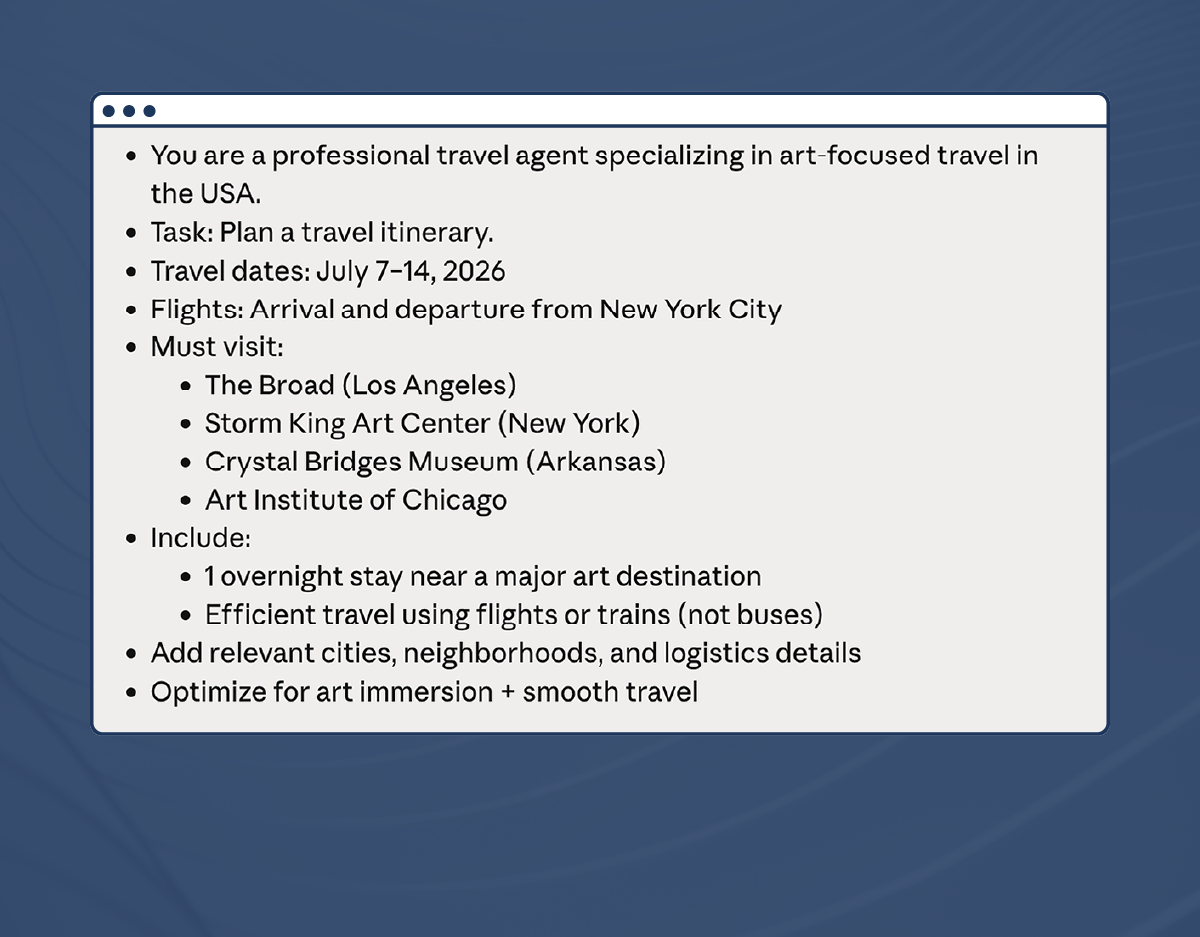
Before we talk about what comes next, it helps to see what that turning point looks like when real travelers stop copy‑pasting generic prompts and start treating AI like a full trip‑planning assistant.
How Are Travelers Becoming More AI-Literate?
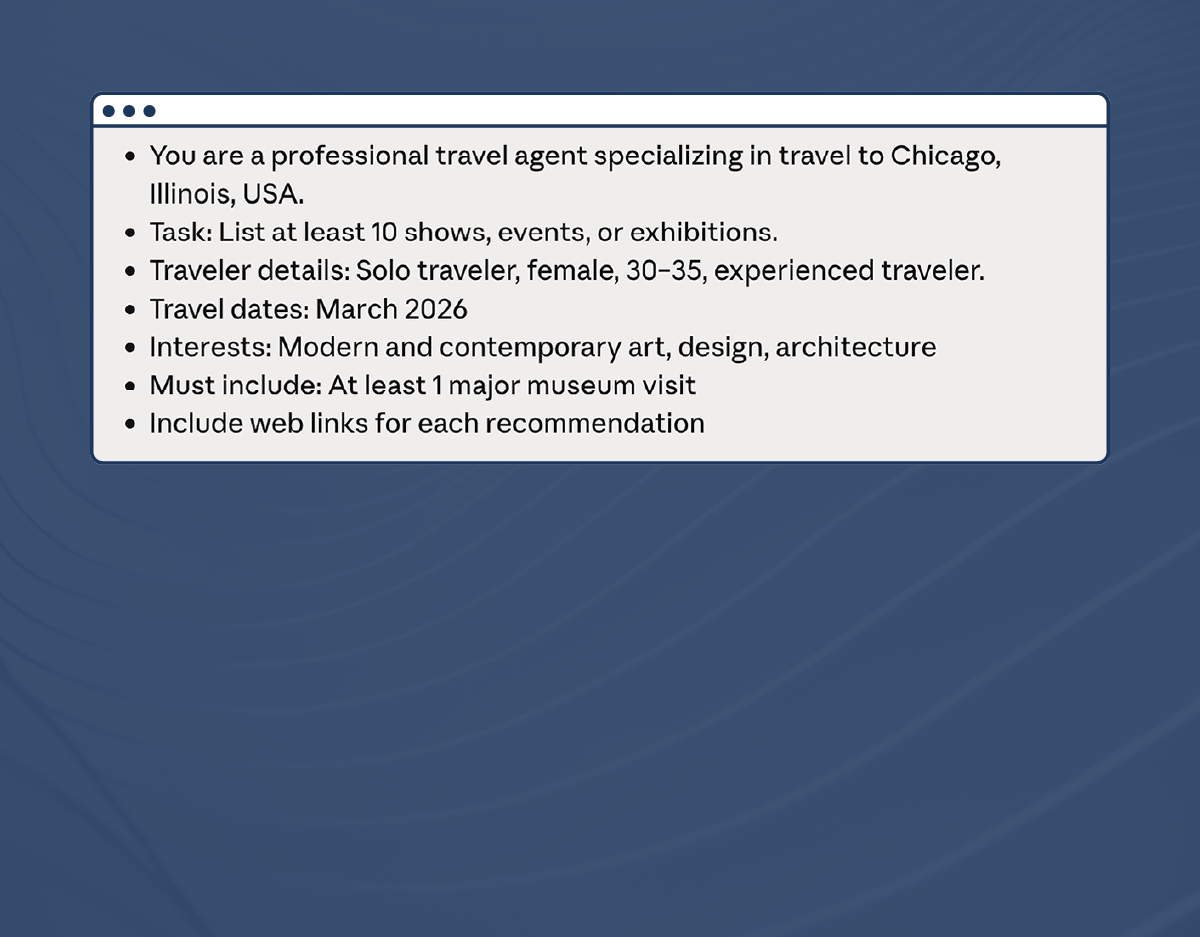
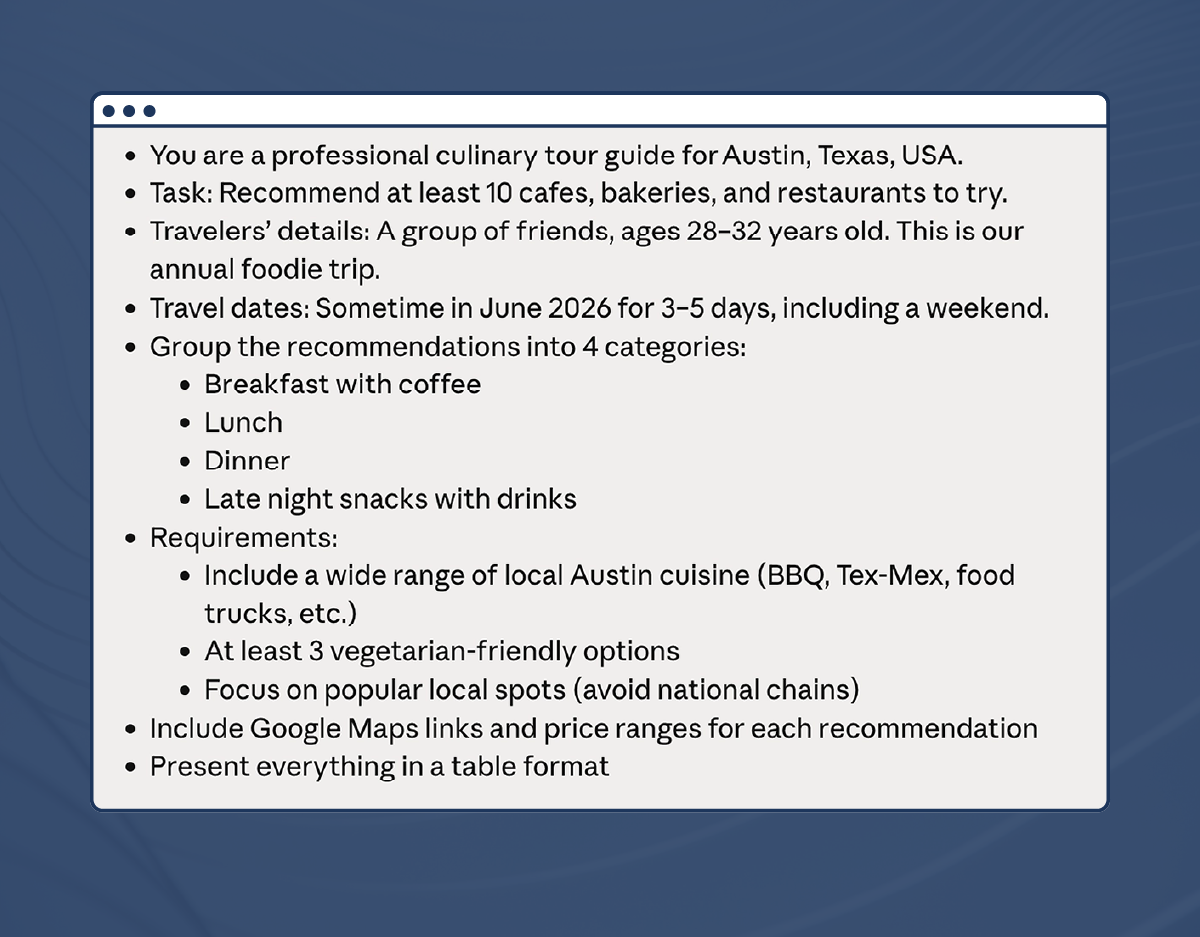
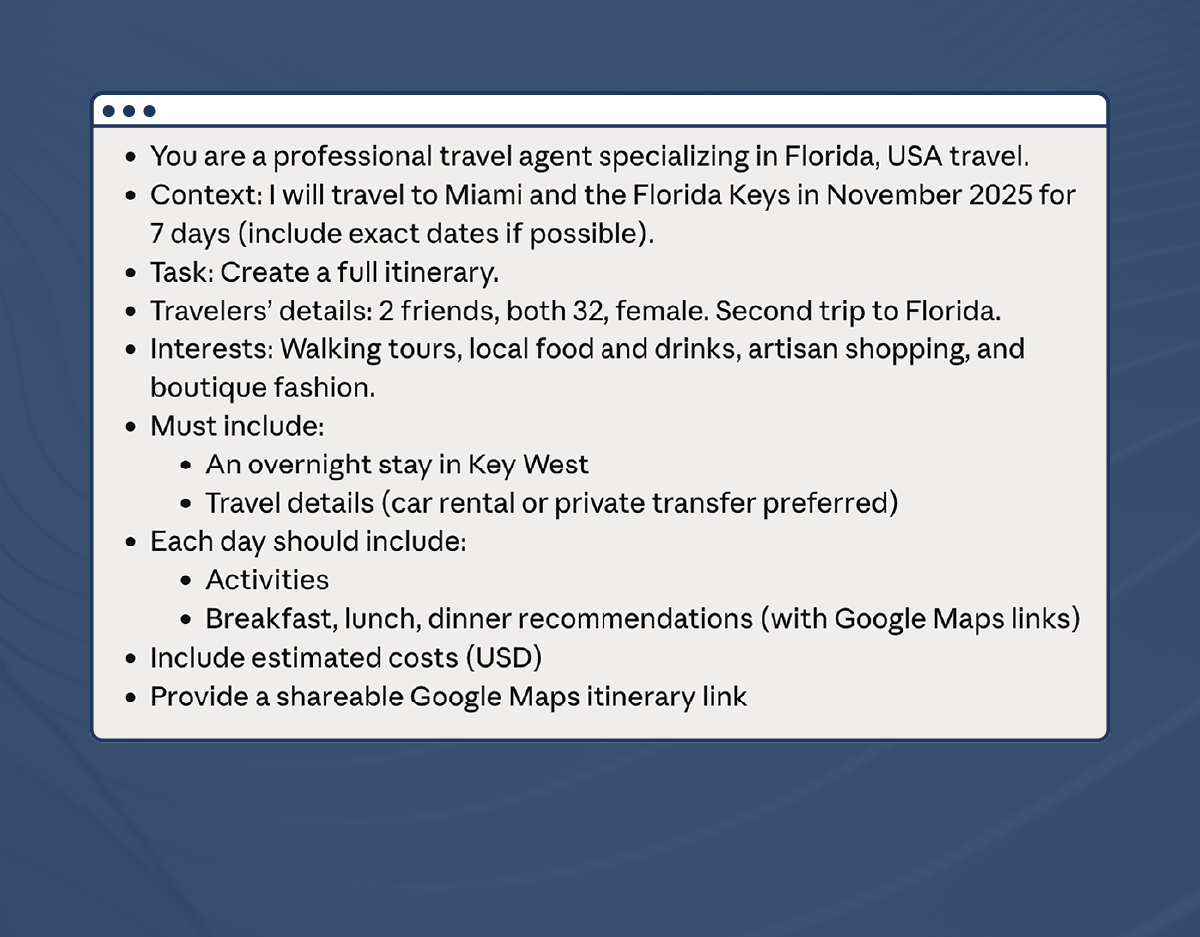
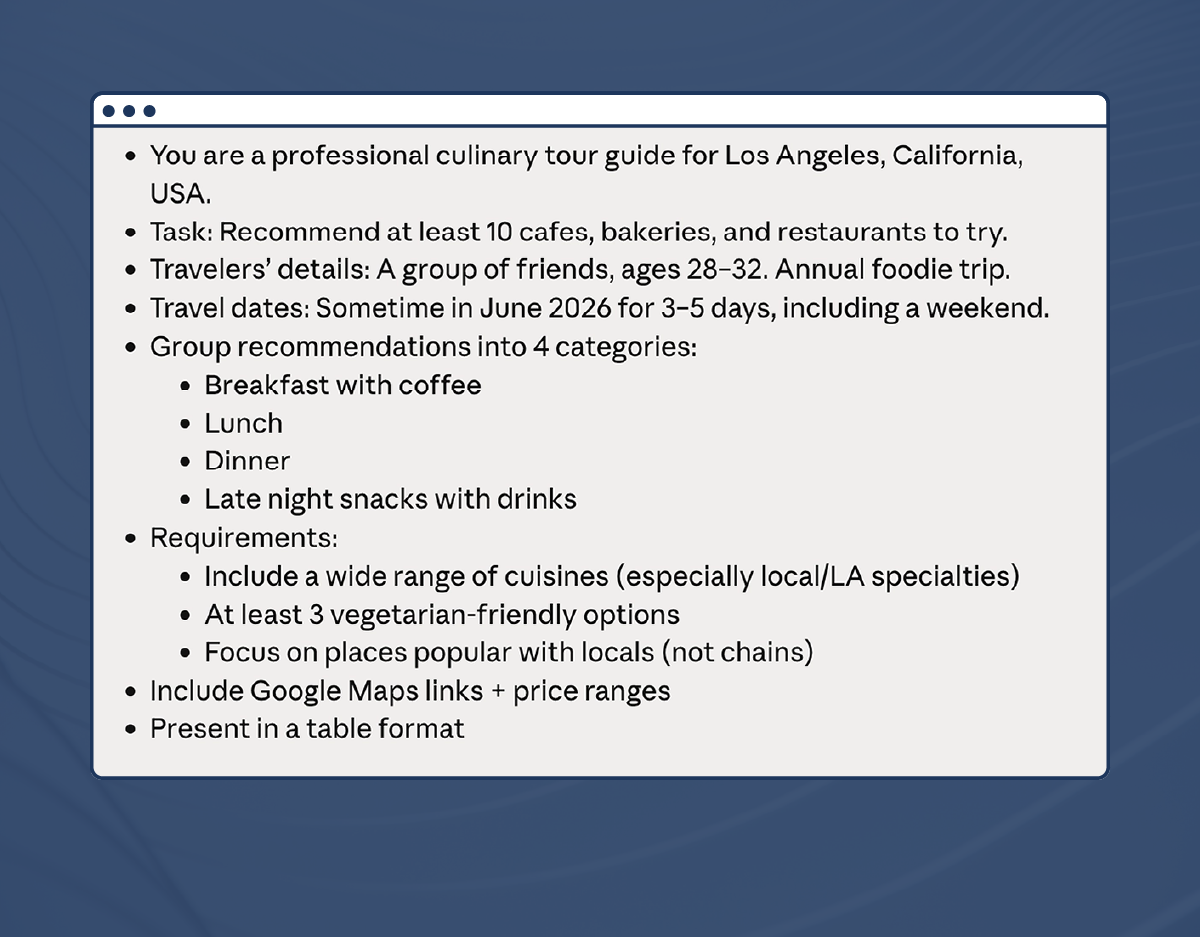
What we’re witnessing now is a second, more consequential shift: travelers are becoming AI-literate. The novelty has worn off, replaced by genuine fluency. A confident AI-user, planning a Portland trip, won’t ask “things to do in Portland this week.” Now users define their traveler persona, specify their interests, set output requirements, and demand sourced links.
This is not a search query or a simple prompt; it’s a creative brief. And increasingly, it’s how experienced travelers talk to AI.

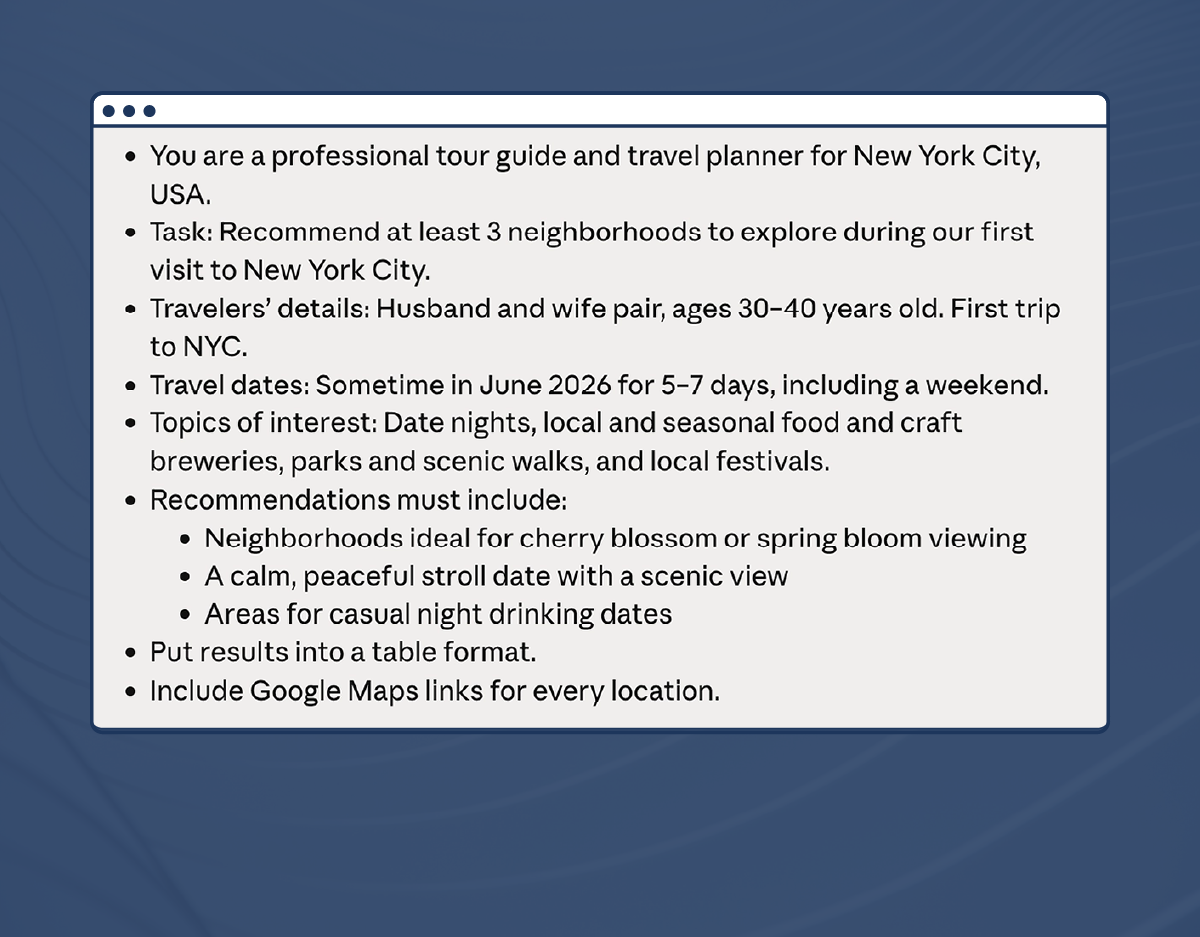
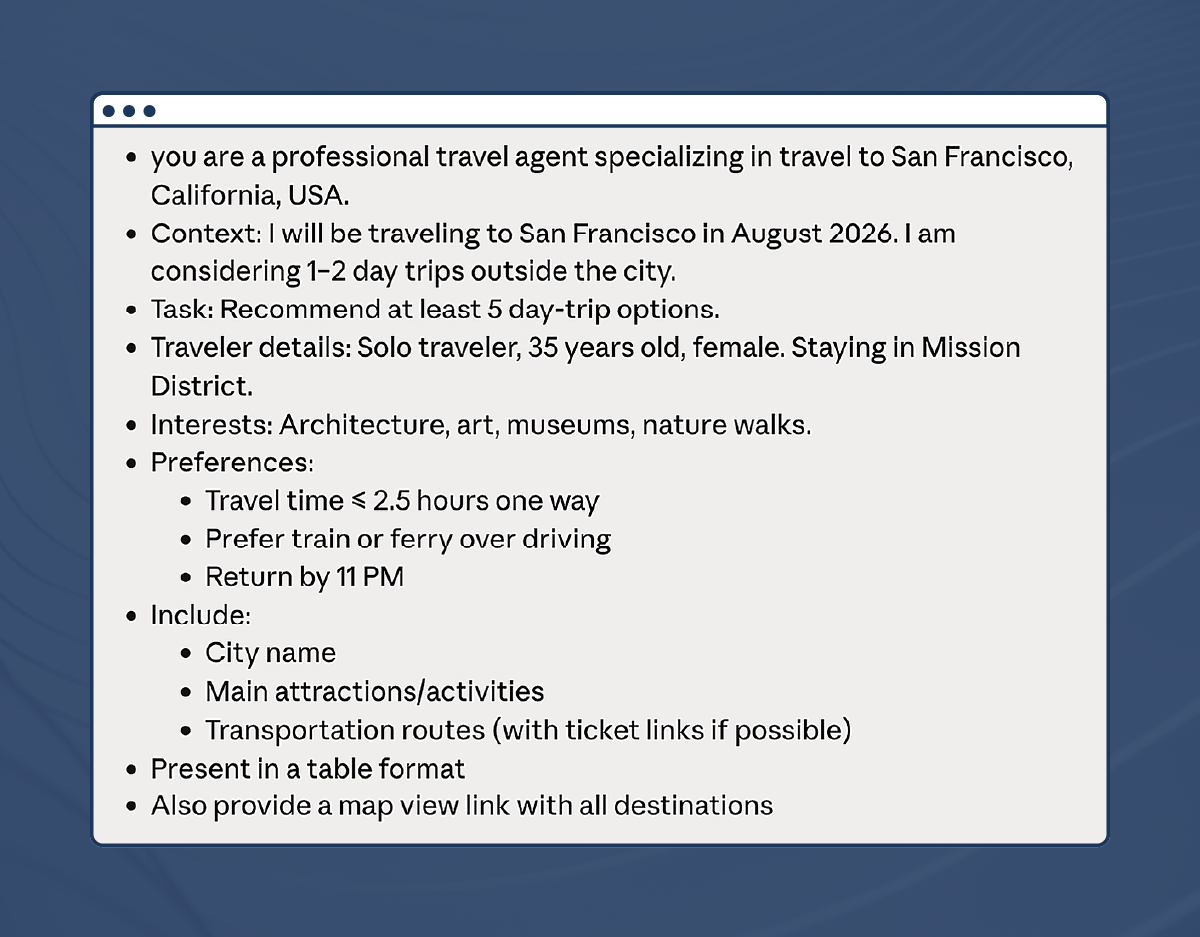
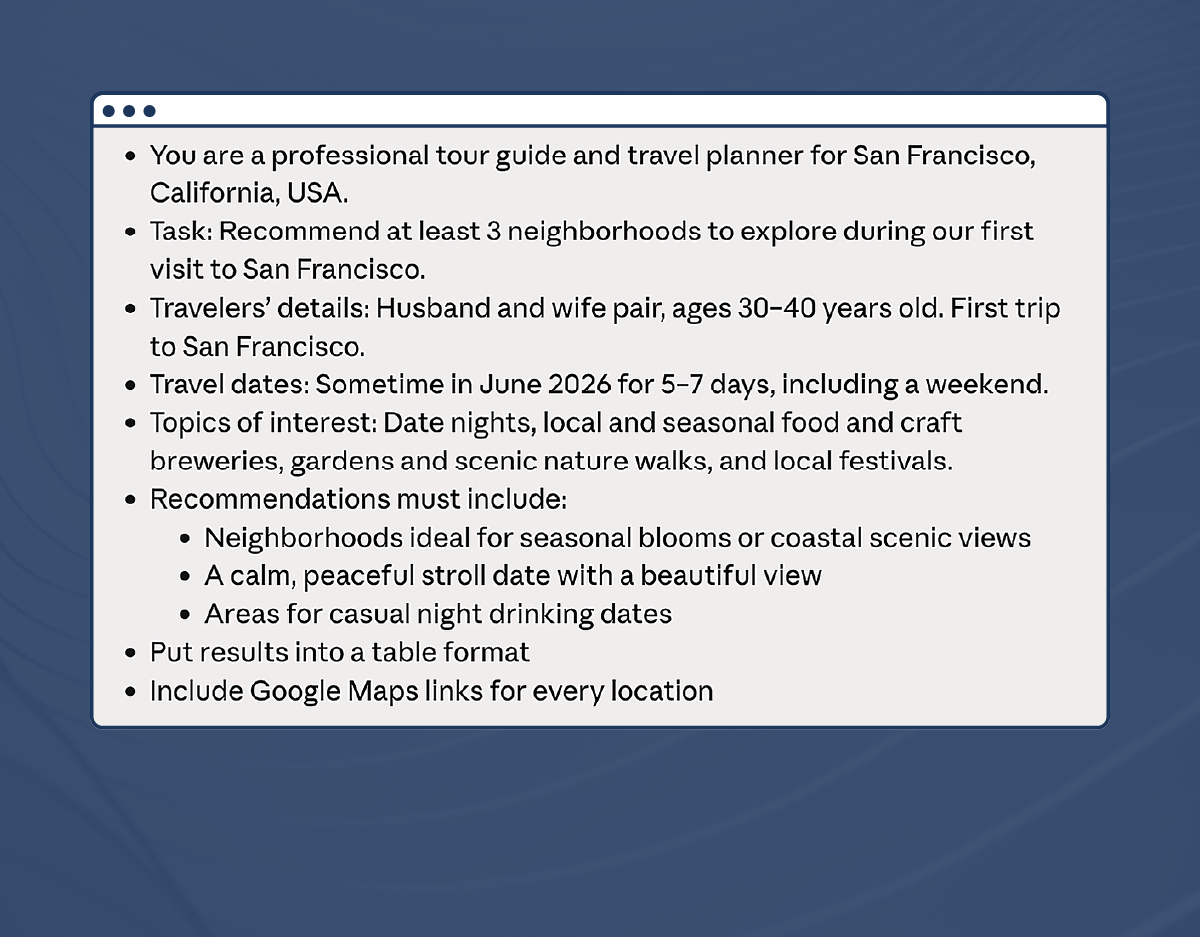
As that fluency spread, it created a new class of frustrated power users: people who knew exactly how to ask, but had no tool capable of fully delivering.
And a new category of AI-native travel tools emerged to meet travelers where they now are. AI travel platforms like Layla, Mindtrip, DocentPro, and Tryp.com weren’t built by adding a chatbot to a legacy booking engine. They were designed from scratch for travelers who want to iterate, converse, and move from inspiration to itinerary without switching tabs or platforms.
![[ Diagram] Evolution of travel research from keyword search to structured prompts and AI agents](https://uof.digital/wp-content/uploads/evolution-of-travel-research-1178x1080.png)
What Are Consumer-Side Travel Agents and Why Do They Matter More Now?
What’s new and underreported is consumer-side agents. As powerful as AI agents deployed by companies are, it’s DIY agents (agents of customers) that are the real source of disruption for marketing in this new AI era. Scott Brinker and Frans Riemersma’s recent report suggests that these “agents of customers” are now a distinct third domain of marketing AI, sitting completely outside brand control, alongside agents for marketers and agents for customers that companies still manage directly.
![[Flowchart] 3 domains of AI marketing agents for marketers, customers, and autonomous customer-side agents](https://uof.digital/wp-content/uploads/3-domains-of-AI-agents-in-marketing.png)
A growing segment of technically fluent travelers is building their own: lightweight personal assistants configured around their specific loyalty status, price thresholds, travel patterns, and preferences. These agents browse and query. They don’t focus on marketing copy or beautiful creatives; they parse structured data.
In Scott Brinker’s framing, they behave like a new kind of non‑human buyer: they shortlist, compare, and negotiate on behalf of the human, long before any brand-owned touchpoint gets a chance to make its case.
What Happens When Travelers’ Agents Negotiate With Brands’ Agents?
This is what makes the current moment genuinely different from every previous wave of travel tech disruption. We are moving toward a world where agents negotiate with agents, where a traveler’s personal AI reaches out to a brand’s AI before a human ever gets involved.
And because so much of that evaluation now happens inside AI systems rather than on websites or search results, brands risk losing 20–50% of traditional search traffic as decisions shift into AI-powered discovery and comparison.
For travel brands, the implications are concrete: if your inventory isn’t agent-readable, your offers aren’t personalized enough to survive autonomous comparison, or your booking infrastructure requires a human to navigate it, you will simply be filtered out before the traveler even sees you.
In a world where half of consumers already use AI search to shape purchase decisions, and hundreds of billions in spend will soon flow through these agents, “being findable” now means being intelligible to someone’s personal AI, not just ranking on Google.
If AI is Making Travel Easier, Why is it Making Marketing Harder?
The traveler’s journey is being rebuilt around AI, but that new journey is increasingly invisible to the brands trying to serve it.
As AI makes planning radically smoother for travelers with fewer tabs, fewer decisions, and more confidence, it quietly makes life harder for the people running brands.
The same tools that collapse the traveler’s research into a single conversational surface explode the number of places your brand has to show up: AI summaries, itinerary builders, agent marketplaces, and private DIY agents. You get a consumer-first discovery layer that feels almost effortless on the demand side, and a sprawling, harder-to-measure landscape on the supply side.
Where Is Traveler Intent Now Being Shaped?
Travelers are also extending their AI toolset in every direction: travel‑first AI planners, maps and routing tools, flight and price engines, general assistants, and niche utilities for visas, insurance, and safety.
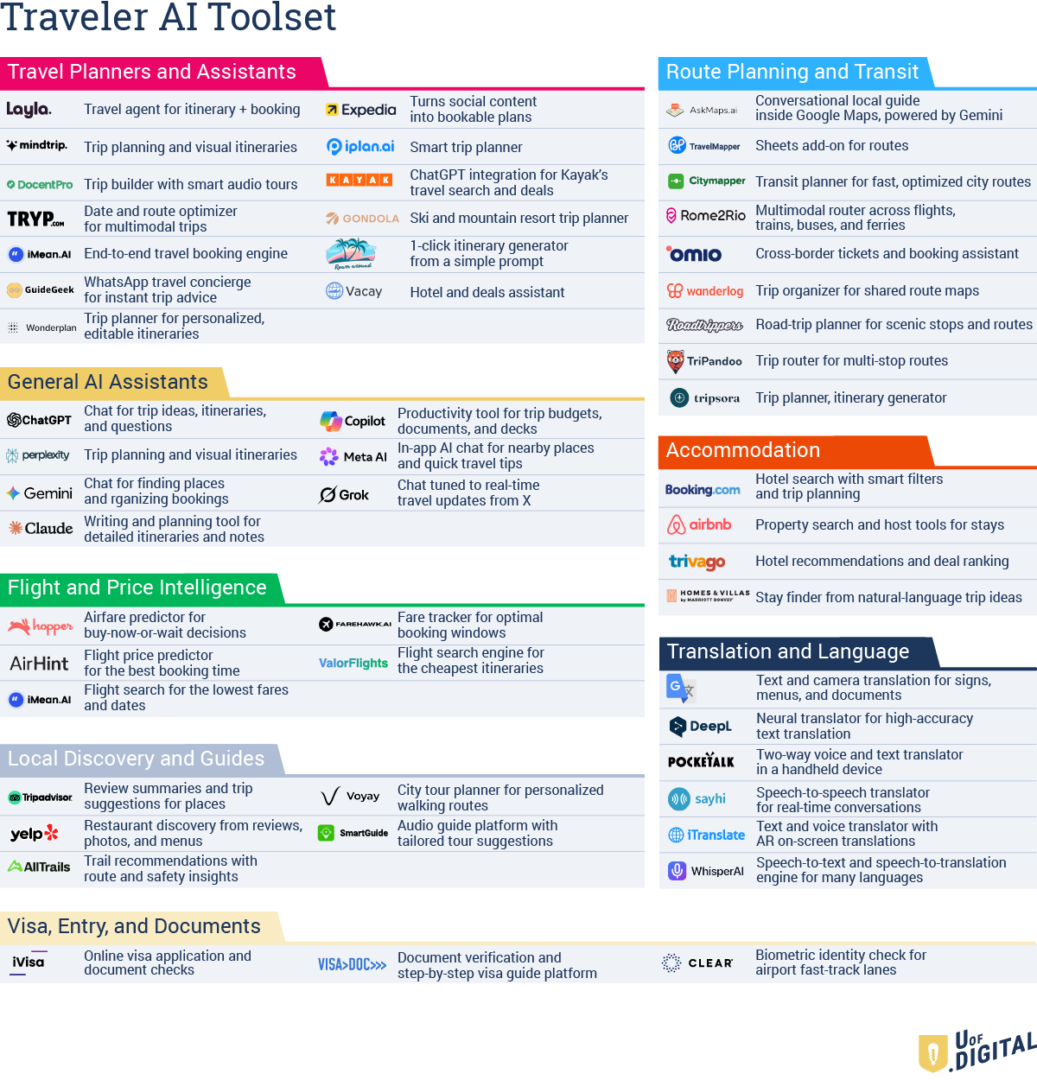
Each of these tools is another surface where their intent is refined, and your brand may or may not appear. For the traveler, this stack feels empowering and low‑friction; for an AI‑focused brand manager, it means more surfaces to understand, optimize for, and monitor, often with very little direct data coming back.
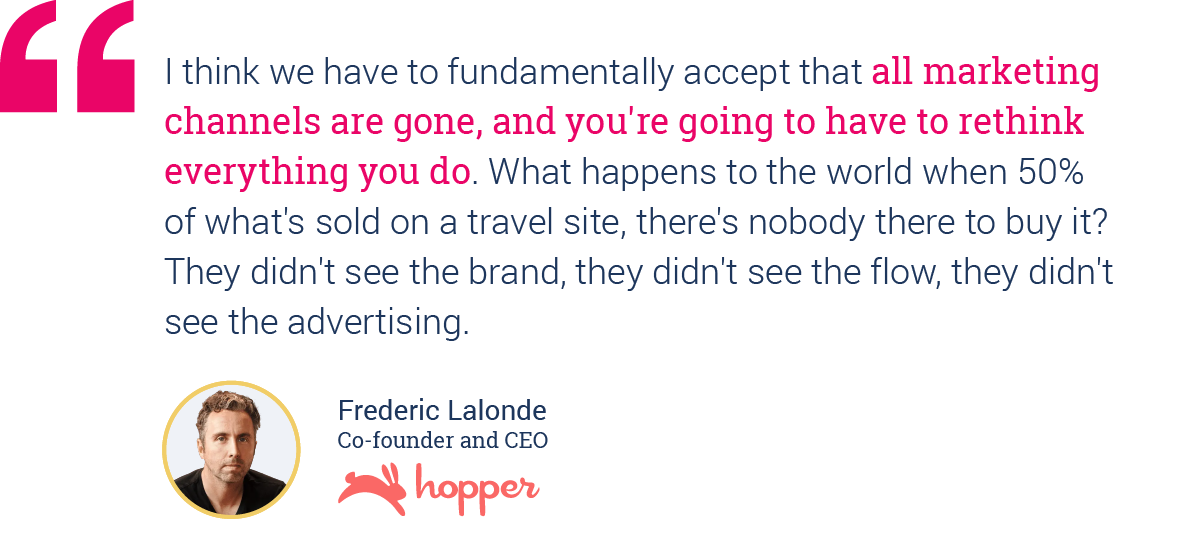
This creates three implications. First, more of the journey is happening “offstage,” inside AI assistants and agents where your analytics tags don’t fire, so familiar metrics like search impressions and site sessions describe a shrinking slice of reality.
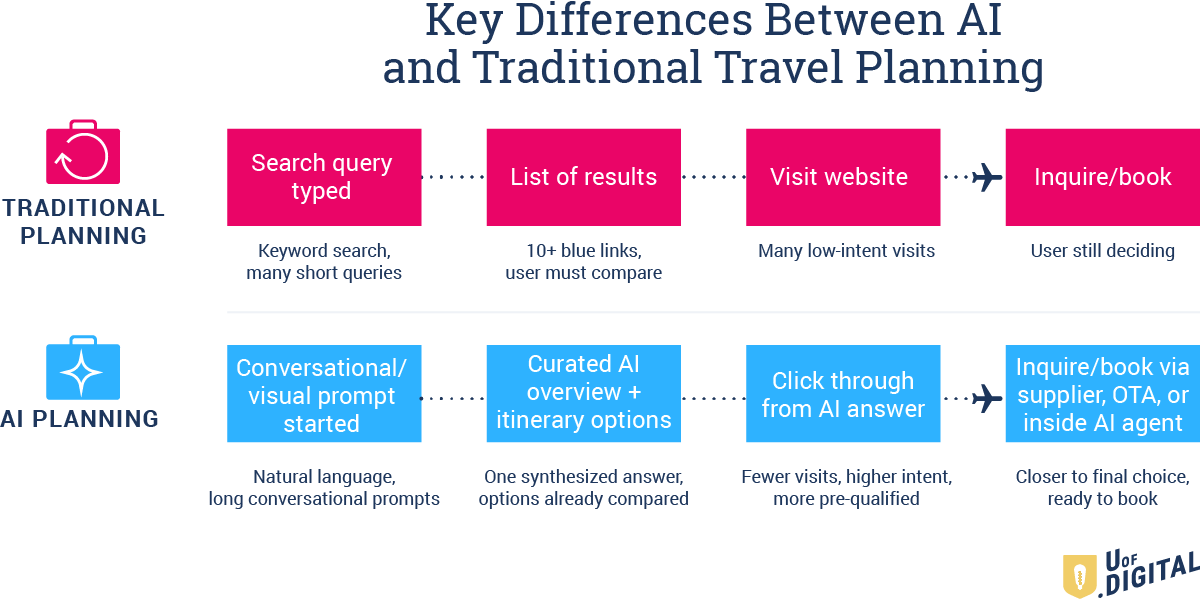
Second, AI search and recommendation engines are still a black box: you don’t really know why one hotel, route, or experience is surfaced over another, or how long you’ll stay in that shortlist before a newer, better‑trained model quietly pushes you out.
Third, the shelf life of visibility is shrinking; winning brand citation and mentions once in an AI result is no longer enough when models constantly retrain on fresh behavior, inventory, and pricing.
How Can You Improve Your Odds of Being Picked by AI?
Yet this isn’t a total loss of control. Just as SEO was about influencing how you showed up in Google’s blue links, a new discipline, AI Optimization (sometimes called Generative Engine Optimization), is emerging to influence how you show up in AI answers and agent workflows.
A new wave of tools is helping brands structure their data, track how they’re mentioned in AI outputs, and get at least directional insight into where they’re gaining or losing ground, even if the underlying engines remain opaque.
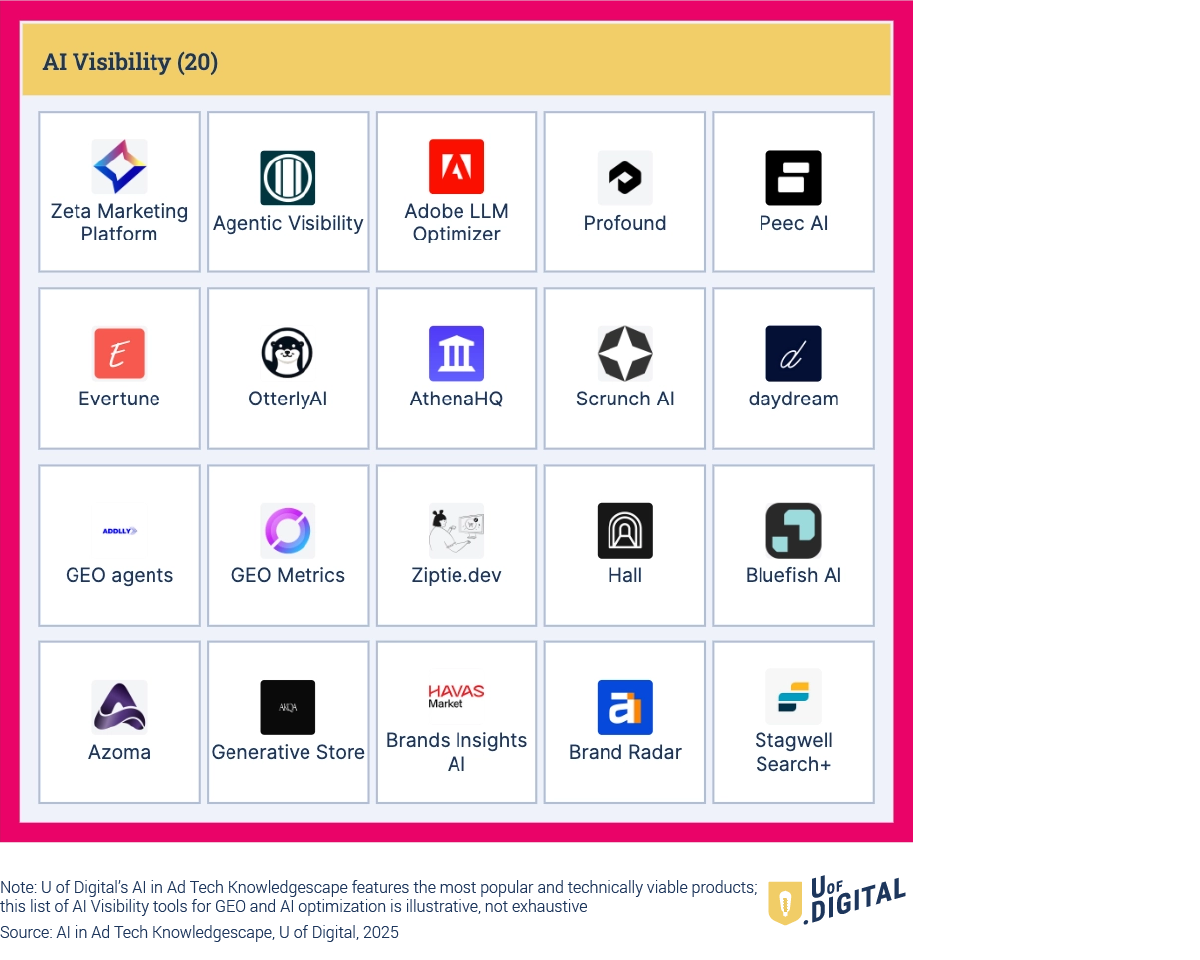
This is why this change in traveler behavior matters so much. The journey has moved into environments where you can’t easily see, measure, or intervene, yet those hidden moments of AI‑driven filtering and comparison are where you’re now being selected or discarded.
In a world where agents negotiate with agents, leading AI strategy for a travel brand means understanding not just your customer, but also the ecosystem of tools and engines that now sit between your inventory and their intent.
Final thoughts
For airlines, OTAs, and hotel brands, the hardest part of this shift is that success is suddenly much tougher to measure. The traveler’s decision now happens inside opaque AI chats and personal agents, not on a page where you can easily track views, clicks, or attribution, which makes traditional marketing dashboards feel out of sync with how trips are actually being planned today.
As discovery, comparison, and even negotiation move into these AI layers, teams are left guessing which levers to pull, which channels to prioritize, and how to show ROI on experiments that span search, agents, email, apps, and loyalty at the same time.
That’s exactly the gap we built AI & Travel: Disrupting the OTA Model to fill.
AI & Travel: Disrupting the OTA Model
Navigate the AI Revolution in Travel Marketing
Perfect for: Travel marketers, OTA professionals, airline and hotel marketing teams
- Understand how travelers are using LLMs to research and book trips
- Analyze threats and opportunities for OTAs, airlines, hotels, and brands
- Design marketing strategies that thrive in an AI-assisted travel landscape
Industry-specific pricing – Join waitlist to secure this rate

In this virtual workshop, we go beyond high-level trend slides into concrete examples of how AI is reshaping traveler intent signals, what “optimization” looks like when your offers are being evaluated by agents rather than humans, and which metrics actually matter when AI is doing the research and shortlisting. You’ll see real cases from airlines, OTAs, and hotel groups, get a guided tour of the tools and data sources leading teams are using right now, and learn practical frameworks you can take back to your next quarterly plan.
If your team is asking questions like “How do we get surfaced in AI trip planners?”, “What do we measure when search traffic drops but bookings don’t?”, or “How do we brief our own agents so they can talk to customers’ agents?” This workshop is designed for you.
Join the waitlist to secure the industry-specific rate and use the session to stress-test your current strategy, pressure-check your KPIs, and leave with a clearer roadmap for competing in an AI-assisted travel market.
FAQs
AI in travel helps people plan trips more easily by answering questions in plain language, suggesting routes, stays, and activities, and comparing options before they book. It can also watch for better prices, flag important details like visas or insurance, and save past preferences to make future trips smoother.
AI in travel booking powers dynamic pricing, smarter search, and conversational assistants that help travelers choose and buy trips. It also underpins emerging agentic tools that can research options and increasingly book on a traveler’s behalf.
AI is unlikely to fully replace travel agents any time soon. Agentic AI may automate many booking tasks, but human agents retain value for complex, high‑emotion trips, so the near‑term outcome is more augmentation than full replacement.